
UEFA Champions League Betting Guide 2026
-
 Dalius Mikalauskas
 -
02 Apr 202612 min. read

Millions of fans and bettors watch the Champions League every year. However, you need more than a gut feeling to make Champions League betting successful and maybe even profitable.
By the end of this guide, you will have valuable insights on how to bet on Champions League matches smartly – from reading odds to placing your bets on the right markets.
Table of content
- Key Takeaways
- Champions League Betting Markets
- How to Research Before You Bet on the Champions League
- Betting Strategies for Each UCL Stage
- Advanced Techniques to Maximise UCL Betting
- Common Champions League Betting Mistakes to Avoid
- Understanding UEFA Champions League Betting Odds
- Choosing the Right Bookmaker for Your UCL Bet
- What Makes Champions League Betting Different?
- How Does the Latest Champions League Format Work?
- The History of UEFA Champions League
- UCL Responsible Gambling & Bankroll Management
Key Takeaways
- Fewer matches make UCL stats less reliable than domestic leagues.
- Teams often play more cautiously and tactically, especially in knockout rounds.
- Motivation varies heavily depending on the stage and standings.
- Clubs frequently rotate squads due to midweek scheduling and travel.
- Bookmakers can be less accurate, especially with smaller or less familiar teams.
- League games are more open, while knockouts are more tactical.
Champions League Betting Markets
There are many popular Champions League betting markets and unique betting opportunities for every match. Each market focuses on a different aspect of the game.
The main betting markets you will see when betting on Champions League matches include:
| Market | What you bet on |
|---|---|
| Match Result (1X2) | Home win, draw, or away win |
| Draw No Bet | Your team must win, while a draw returns your money |
| Double Chance | Covers two outcomes in one bet |
| Handicap | One team starts with a goal advantage or disadvantage |
| Over/Under Goals | Total number of goals in the match |
| BTTS | Whether both teams score |
| Player Markets | Goals, assists, cards, or other player events |
| Futures / Outrights | Long-term bets, such as a tournament winner |
| Live Betting | Bets placed while the match is in progress |
Match Result (1X2)
In this market, you choose which of the three outcomes will happen: the home team wins, the match ends in a draw, or the away team wins. This is the most common football betting market and is often used when one team looks way stronger on paper.
Draw No Bet
Here, you bet on one team to win the match. If your team wins, the UEFA Champions League bet pays out. If the match ends in a draw, your money is returned instead of counting as a loss. It’s most useful when you believe a team has a good chance to win, but the match could still be close.
Double Chance
Double Chance lets you bet on two outcomes at the same time. For example, you can cover a win or a draw for one team. This makes the bet safer because more results work in your favor, although the odds are usually lower.
Handicap Betting
Handicap betting for Champions League adds a virtual goal advantage or disadvantage before the match begins. For example, a −1 handicap means the team must win by at least two goals. This market is useful when one team is much stronger, and it helps create better odds when backing that team.
Over/Under Goals
In over/under betting market, you predict whether the total number of goals will be above or below a specific line, most commonly 2.5. In Champions League knockout matches, teams often play more carefully, so lower goal totals are more common.
BTTS (Both Teams to Score)
With BTTS, you bet on whether both teams will score at least one goal during the match. You simply choose Yes or No. In the Champions League, this market is often popular in matches between strong attacking teams, especially when both sides need good results to progress.
Player Markets
Player markets focus on individual player actions. Common bets include anytime goalscorer, first goalscorer, assists, or cards. In most cases, it’s useful to check who takes penalties and set pieces, as these players often have a higher chance of scoring in this market.
Futures & Outrights
These bets focus on the overall tournament rather than a single match. Examples include Champions League winner bet, the top goalscorer, or teams reaching the semi-finals. However, this market keeps your money tied up until the outcome is decided.
Live Betting
In-play betting, also called live betting, allows you to place bets while the match is already in progress. Odds update constantly during the game, especially after goals or red cards.
Watching the match live usually helps you notice momentum shifts and late goals that automated odds may not capture.
How to Research Before You Bet on the Champions League
Doing a bit of research before each Champions League bet makes a huge difference. You do not need to spend hours on it – focus on these four things.
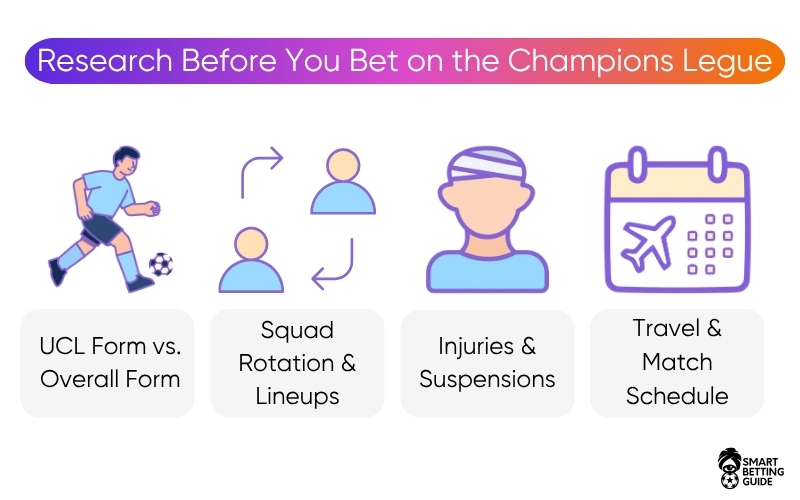
UCL Form vs. Overall Form
Focus on recent Champions League performances, not just domestic results. Teams often approach European matches differently, so reviewing the last 4–5 UCL season games – especially against top clubs like Real Madrid, Liverpool, or PSG – gives a clearer picture of their level.
Squad Rotation & Lineups
Managers rotate players during busy periods. Check if the team had a match a few days earlier and whether key players were rested or subbed early. Press conferences and predicted lineups can also help identify who is likely to start and if a full-strength squad is expected.
Injuries & Suspensions
Missing players change the balance of a match. Attacking absences reduces goal threat, while missing defenders or goalkeepers weakens the defense. In the Champions League, suspensions – especially from yellow card accumulation – are also significant.
Travel & Match Schedule
Long travel and tight schedules can affect performance. Teams that recently played and traveled across Europe with limited rest are more likely to be fatigued. This is especially relevant in European competitions where clubs regularly fly across the continent.
Betting Strategies for Each UCL Stage
Team motivation, squad rotation, and match tactics vary by competition stage, from qualifying rounds to the final. Thus, the best approach also differs.
UCL Betting Tips for the League Phase
League phase matches can be unpredictable, as teams balance domestic and European fixtures. Some rotate heavily, while others prioritize the UCL, making early rounds harder to read. As the phase progresses, motivation becomes clearer, often leading to more open games.
Because of these differences:
- BTTS can work well when both teams still need points.
- Over 2.5 goals appear often when attacking teams face each other.
- Double Chance can be useful when backing a stronger team.
UCL Betting Tips for the Knockout Rounds
Knockout ties are more tactical, with teams focusing on the aggregate score. First legs are often cautious, while second legs depend heavily on the earlier result – especially if one team is forced to chase the game.
In this stage:
- Under 2.5 goals is common in the first match.
- Over goals become more likely when one team needs to score.
- Draw No Bet is useful when backing the stronger team in close matches.
UCL Betting Tips for the Finals
The final is a single match on neutral ground, so teams usually start carefully and avoid early mistakes. With two strong sides, games tend to be tight and slower.
Common approaches include:
- Under 2.5 goals due to fewer chances.
- Low correct scores, such as 1–0 or 1–1, in close matches.
- Draw at halftime as teams begin cautiously.
Advanced Techniques to Maximise UCL Betting
If you want to take your Champions League betting a bit further, look beyond the basic odds. A few simple habits will help you spot better opportunities and avoid overpriced bets.
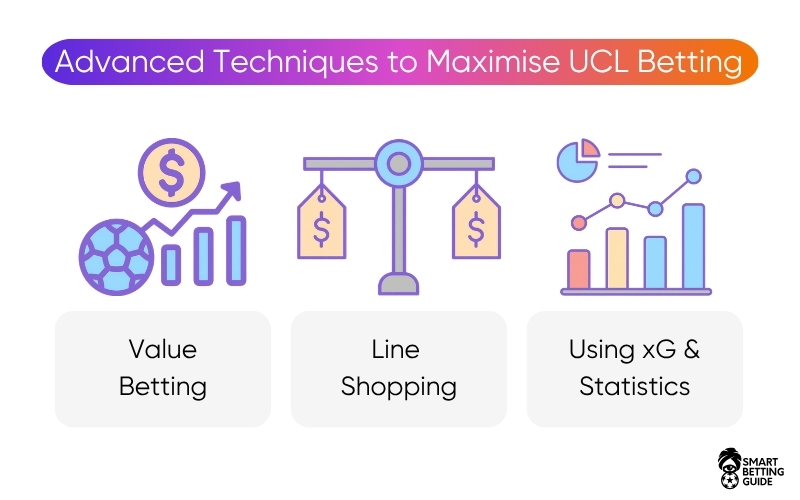
Value Betting
Look for situations where the odds are higher than the real probability. This usually comes from team form or historical performance being mispriced.
For example, if a team has around a 50% chance of winning but the odds suggest closer to 40%, the value is on your side. Even small differences – like odds moving from 2.10 to 2.25 – can improve long-term returns.
Line Shopping
Odds can vary between bookmakers, even for the same match. Comparing at least 3–4 sites and choosing the highest price increases your potential payout. Small changes in odds, such as 2.10 to 2.25, make a noticeable difference over time.
Using xG & Statistics
Expected Goals (xG) reveal how dangerous a team actually is in attack.
For example, 1.8 xG vs 0.6 xG usually means one team is clearly more dangerous.
In such cases, bets like Over 2.5 goals or Both Teams To Score can be worth considering, especially if similar patterns appear in recent matches. You can check free xG data on sites like FBref or Understat.
Common Champions League Betting Mistakes to Avoid
Even good match analysis can fail if basic betting habits are poor. Many losses come from simple betting mistakes that are actually easy to avoid once you know what they are.
❌ Backing the favourites to win the Champions League only because of their reputation.
❌ Forgetting that a team needing only a draw will usually play much more defensively.
❌ Judging teams only by domestic form against stronger European opponents.
❌ Overlooking long midweek travel, which can affect the team’s away performances.
❌ Expecting open games when the first meeting between two teams is often cautious.
❌ Ignoring the motivation gaps between qualified teams and those fighting to advance.
❌ Underestimating how smaller clubs often focus mainly on defending against elite teams.
❌ Betting before Champions League lineups are confirmed.
Understanding UEFA Champions League Betting Odds
Odds indicate both the possible payout and the probability a bookmaker assigns to an outcome. In other words, they show how bookmakers assess the likelihood of each outcome.
Before you place any bet, including those with enhanced odds or promotional offers, you need to understand what the odds are telling you:
| Format | Example | What it means |
|---|---|---|
| Decimal | 2.50 | You receive €2.50 for every €1 you bet (€1.50 profit). |
| American | +150 / -200 | +150 means you win €1.50 for every €1 bet. −200 means you need to bet €2 to win €1. |
| Fractional | 3/1 | You win €3 profit for every €1 you bet. |
Implied Probability & Bookmaker’s Margin in Betting Odds
One of the most useful concepts in Champions League betting is implied probability. Every set of odds tells you what chance the bookmaker thinks an outcome has. The formula is simple:
Implied probability (%) = (1 ÷ decimal odds) × 100
For example, odds of 2.50 equal an implied probability of 40%. This means the bookmaker believes the outcome will happen about 40% of the time.
Another factor to understand is the bookmaker’s margin. If you add the implied probabilities of all possible outcomes in a match, the total will usually exceed 100%.
This extra percentage is how bookmakers make their profit. In Champions League matches, it is usually around 5–8%, and the lower the margin, the better it is for bettors.
Choosing the Right Bookmaker for Your UCL Bet
Where you bet matters more than you think. Differences in odds, limits, and markets always add up over a full Champions League season, and can influence your betting decisions significantly
Thus, before choosing a sports betting site, run a few quick checks:
Compare the odds on the same match
Check at least 3–4 online betting platforms and compare prices on markets like 1X2 or Over 2.5. For example, odds of 2.25 instead of 2.10 increase returns by about 7% on the same bet.
Check the bookmaker’s margin
Lower margins mean better value. The best sports betting sites usually run margins of around 4–6% on major Champions League games, while weaker ones can run margins of 8–10%.
Look at the number of match markets
The best bookmakers offer 150–300 markets per Champions League match, including Asian handicaps, player shots, corners, and cards. Meanwhile, not-so-great betting sites offer only a few options.
Check the limits on Champions League bets
Reliable online sports betting platforms allow higher stakes on major matches, often €2,000–€10,000 or even more on main markets like match winner or Over/Under 2.5 goals.
Verify the licence and regulation
Choose only online bookmakers regulated by trustworthy authorities such as the UKGC or the MGA. These licenses require the betting site to have financial protection and reliable dispute-resolution procedures.
Read the bonus conditions carefully
Some bonuses require 60x betting with minimum odds around 1.70–1.80, meaning that for a €100 bonus, you’ll need to spend €6,000 on bets before withdrawing any winnings.
Check live betting options
Reliable betting platforms offer fast updates and many in-play markets such as next goal, next card, or total corners.
Check payout speed and payment methods
Bookmakers with a strong reputation usually process withdrawals within 24–48 hours and support common payment methods, including bank transfers, cards, e-wallets, and even cryptocurrencies.
What Makes Champions League Betting Different?
Many bettors assume the Champions League works just like a domestic league. It does not. The unpredictability of the Champions League sets it apart.
The key differences between the domestic and UEFA Champions Leagues are:
| Factor | Domestic League | Champions League |
|---|---|---|
| Number of matches | 38 per season | Only 8 in the league phase |
| Playing style | More open and attacking | More careful and defensive |
| Squad rotation | Fairly consistent | Very common, especially early on |
| Bookmaker accuracy | Well-researched lines | Less accurate for smaller clubs |
With fewer matches than domestic leagues, UCL stats are less reliable. A team might look great on paper, but have only played 4 or 5 European games. That is why watching how teams actually play matters just as much as the numbers.
How Does the Latest Champions League Format Work?
The tournament format and structure affect team motivation, squad selection, and the seriousness with which clubs approach each match from a Champions League betting perspective.
From the 2024/25 season, the Champions League adopted a new format.
The new format removes the system in which 32 teams were divided into eight groups. The tournament now consists of 36 teams, and instead of traditional group stage rounds, all clubs are placed in one single league table.
Each team plays eight home and away matches against different opponents:
| Stage | Format | Details |
|---|---|---|
| League phase | Single league table | 36 teams play 8 matches against different opponents. |
| Playoff round | Home & away matches | Teams ranked 9th–24th play two matches to qualify for the Round of 16. |
| Round of 16 | Two matches per tie | 16 teams face each other in home-and-away games. |
| Quarter-finals | Two matches per tie | Winners are decided on the total score from both games. |
| Semi-finals | Two matches per tie | Teams play one match at home and one away. |
| Finals | Single match | One game at a neutral venue decides the champion. |
One more thing to remember is that throughout the tournament, Champions League games are played midweek. Clubs often rest players when a domestic league match takes place just a few days before or after. Thus, it’s important to check the fixture schedule before placing a bet.
The History of UEFA Champions League
The UEFA Champions League traces its roots back to 1955, when it was first launched as the European Cup – a knockout competition to determine the best club side on the continent. Initially, only league champions competed, with ties played over two legs.
In 1992, it was rebranded as the UEFA Champions League, expanding to include top teams beyond just champions. This shift increased its prestige and global appeal.
Today, the UEFA Champions League is Europe’s most-watched club competition, attracting top teams and players, and it remains the main focus of football discussions and betting markets.
UCL Responsible Gambling & Bankroll Management
Managing your Champions League betting budget properly helps keep betting under control and prevents unnecessary losses. Many bettors focus only on picking the right matches, but long-term results depend just as much on how you manage your money.
- Only bet what you can afford to lose, never money meant for bills or daily expenses.
- Keep stakes small, around 1–2% of your bankroll per bet (rarely above 5%).
- Set deposit and loss limits in advance to avoid emotional decisions.
- Track your bets, including odds, stake, and results, to spot patterns and improve.
If managing your bankroll becomes difficult and betting stops being enjoyable or starts causing stress, it’s a sign to take a break and seek help. Support for such cases is always available. You can contact GamCare, BeGambleAware, or the National Council on Problem Gambling for help.
FAQ About Champions League Betting
⭐ What is the best bet for the Champions League?
There is no single best bet, because the right market depends on the teams, motivation, and match situation. However, common choices include Over/Under goals, BTTS, and Draw No Bet, especially in matches where team strength or tactics are clearly visible
⭐ How do Champions League betting odds work?
Champions League betting odds show both the potential payout and the bookmaker’s estimate of how likely an outcome is. The higher the odds, the less likely the bookmaker believes that outcome will happen.
⭐ Can you bet on the Champions League in the US?
Yes, Champions League betting is available in many US states where sports betting is legal. However, availability depends on local state regulations and licensed bookmakers.
⭐ Is Champions League betting profitable?
Champions League betting can be profitable in the long term if you consistently find value in the odds and manage your bankroll carefully. However, results are never guaranteed because football outcomes remain unpredictable.
⭐ When do Champions League betting markets open?
Most bookmakers open Champions League betting markets 2–3 days before a match. Additional markets and updated odds usually appear as the match approaches and team news becomes available.
⭐ What are some useful UEFA Champions League betting tips?
Focus on team form, squad rotation, and recent injuries. Betting on markets like Over/Under goals, BTTS, and Asian handicaps can also be profitable.
⭐ Can I bet live on the Champions League final?
Yes, live Champions League final bets are available, with real-time odds and a variety of in-play markets offered by many bookmakers.

Crypto and Sports Betting Expert