
Types of Poker Games: Popular Poker Variations
Poker splits into three core families: Hold’em, Stud, and Draw. Ever sat down at a table, or opened an online lobby, and frozen at a wall of unfamiliar game names? You’re not alone. This guide breaks down every major variant, its learning curve, and where you can actually play it.
Table of content
Key Takeaways
- Poker games fall into three core families: Hold’em, Stud, and Draw
- Texas Hold’em is the easiest variant for beginners to learn
- Omaha deals four hole cards, raising the strategic complexity
- Stud games skip community cards; players see some cards face-up
- Draw poker lets you swap cards to improve your hand
- Learning curve and betting structure vary widely across variants
What Are the Main Types of Poker Games?
Every poker variant belongs to one of three families: Hold’em, Stud, or Draw. Hold’em games share community cards on the table. Stud games deal a mix of face-up and face-down cards with no community cards at all. Draw games let you discard and replace cards to build your final hand.
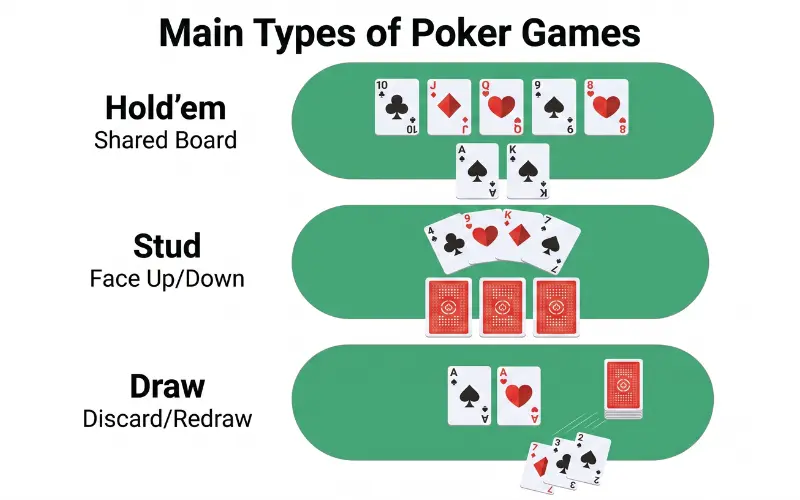
Here’s the core difference at a glance:
| Family | Community Cards | Hole Cards | Card Exchange |
|---|---|---|---|
| Hold’em | Yes (5 shared) | 2–4, face-down | None |
| Stud | No | Mix of face-up/face-down | None |
| Draw | No | 4–5, face-down | Yes, 1–3 rounds |
Once you know which family a game belongs to, its rules become far easier to predict. The sections below cover each family in detail, starting with Hold’em.
Hold’em Poker Games
Hold’em games deal two or more hole cards to each player, then share five community cards across four betting rounds. Players combine their hole cards with the community cards to build the best five-card hand. Texas Hold’em is the most popular variant worldwide, but several spinoffs change the hole-card count or hand rankings.
Texas Hold’em
Texas Hold’em deals two hole cards per player and uses a flop, turn, and river to reveal five community cards. Betting happens in four rounds: pre-flop, flop, turn, and river. Because the rules stay simple, most players learn Texas Hold’em before any other variant.
- Learning curve: Low — ideal for first-time players
- Where it’s played: Every major poker room and casino worldwide
Texas Hold’em Betting Structure
Texas Hold’em runs four betting rounds: pre-flop, flop, turn, and river. In No-Limit games, players can bet any amount up to their entire stack at any time. Pot-Limit caps bets at the current pot size, while Fixed-Limit uses set bet sizes that double after the turn.
- No-Limit: bet up to your full stack, any round
- Pot-Limit: max bet equals the current pot size
- Fixed-Limit: bets double from small to big after the turn
Omaha Poker
Omaha deals four hole cards instead of Hold’em’s two, and players must use exactly two of them with three community cards. This rule raises the strategic complexity significantly compared to Texas Hold’em. However, the four-card structure often produces stronger average hands, so pots tend to grow larger.
- Learning curve: Moderate — the two-card rule takes practice
- Where it’s played: Widely spread online; common in European casinos
Omaha Betting Structure
Omaha almost always uses Pot-Limit betting, capping every bet at the size of the pot. This limit exists because Omaha’s four hole cards produce stronger hands on average, so uncapped betting would inflate pots too fast. No-Limit Omaha exists but appears rarely outside select online rooms.
- Pot-Limit: standard format, bet capped at pot size
- No-Limit: rare, mostly found in niche online games
- Fixed-Limit: uncommon, occasionally used in home games
Omaha Hi-Lo
Omaha Hi-Lo splits the pot between the best high hand and the best qualifying low hand. A low hand needs five cards, each ranked eight or lower, with no pairs. Therefore, players must think about two separate hands at once, which changes starting-hand strategy completely.
- Learning curve: High — split-pot math takes real study
- Where it’s played: Available on major online rooms; less common live
Omaha Hi-Lo Betting Structure
Omaha Hi-Lo follows the same Pot-Limit structure as standard Omaha. Because the pot splits between high and low hands, Pot-Limit betting keeps swings manageable across four rounds. Some casinos also spread Fixed-Limit Omaha Hi-Lo for lower-stakes games.
- Pot-Limit: default format at nearly every table
- Fixed-Limit: found in lower-stakes casino games
- No-Limit: rarely offered for this variant
Short Deck Hold’em
Short Deck Hold’em removes all cards ranked 2 through 5, leaving a 36-card deck. This change makes flushes rarer than full houses, so the hand rankings flip in one key spot. As a result, players see more action and bigger hands than in standard Hold’em.
- Learning curve: Moderate — familiar rules, but rankings reverse
- Where it’s played: Popular in Asian high-stakes rooms; growing online
Short Deck Hold’em Betting Structure
Short Deck Hold’em typically skips blinds and uses an ante-only format, where every player pays before the deal. Betting then proceeds No-Limit or Pot-Limit across four rounds, same as standard Hold’em. The ante structure keeps action high from the very first round.
- Ante-only: every player pays before cards are dealt
- No-Limit: full-stack betting allowed in high-stakes games
- Pot-Limit: used in some online Short Deck tables
Other Types of Hold’em Poker Games
Several lesser-known Hold’em variants add extra cards, extra boards, or extra betting rounds. Courchevel and Big O both descend from Omaha but change how many hole cards players see. The table below compares six variants side by side.
| Variant | Hole Cards | Key Twist | Where It’s Played |
|---|---|---|---|
| Courchevel | 5 | First community card dealt face-up before flop | Mostly European casinos |
| Big O (5-Card Omaha) | 5 | One extra hole card vs. standard Omaha | Online high-stakes tables |
| 5-Card Omaha Hi | 5 | High-hand-only version of Big O | Select online rooms |
| Pineapple Hold’em | 3 | Discard one hole card after the flop | Home games; some online rooms |
| Crazy Pineapple | 3 | Discard happens after seeing the flop, not before | Home games; niche online rooms |
| Manila Hold’em | 5 | Uses a 36-card deck, like Short Deck | Asian casinos |
| Double Board Hold’em | 2 | Two separate community boards run simultaneously | High-stakes cash games only |
Stud Poker Games
Stud games deal a mix of face-up and face-down cards with no community cards at all. Each player builds a hand entirely from their own cards, and opponents’ up-cards reveal partial information throughout the hand. Seven Card Stud remains the most recognized variant, though several spinoffs change the hand ranking or card count.
Seven Card Stud
Seven Card Stud deals seven cards total per player, three face-down and four face-up, across five betting rounds. Players use the best five of their seven cards to form a final hand. Because up-cards stay visible, reading opponents’ boards becomes a core part of strategy.
- Learning curve: Moderate — five betting rounds require more memory than Hold’em
- Where it’s played: Common in home games; available on select online rooms
Seven Card Stud Betting Structure
Seven Card Stud uses Fixed-Limit betting across five rounds: third street, fourth street, fifth street, sixth street, and seventh street. Bet sizes double starting on fifth street, similar to how Fixed-Limit Hold’em doubles after the turn. Pot-Limit and No-Limit versions exist, but casinos rarely spread them.
- Fixed-Limit: standard format, bets double from fifth street onward
- Pot-Limit: rare, found mostly in home games
- No-Limit: uncommon, occasionally offered online
Seven Card Stud Hi-Lo (Stud/8)
Seven Card Stud Hi-Lo splits the pot between the best high hand and the best qualifying low hand. A low hand needs five unpaired cards ranked eight or lower. Therefore, players track two winning paths at once, which changes which starting hands hold real value.
- Learning curve: High — split-pot strategy takes real practice
- Where it’s played: Available on major online rooms; less common live
Seven Card Stud Hi-Lo Betting Structure
Seven Card Stud Hi-Lo follows the same Fixed-Limit structure as standard Seven Card Stud. Because the pot splits between high and low hands, Fixed-Limit betting keeps swings predictable across five rounds. This format also makes the game a common choice for mixed-game tournaments like HORSE.
- Fixed-Limit: default format at nearly every table
- Used in HORSE: one of five rotating games
- Pot-Limit/No-Limit: rarely offered for this variant
Razz Poker
Razz uses standard Seven Card Stud dealing, but only the lowest hand wins the entire pot. Straights and flushes don’t count against a low hand, so the wheel (A-2-3-4-5) ranks as the best possible hand. As a result, players must unlearn typical high-hand instincts to succeed.
- Learning curve: High — low-hand-only strategy feels unfamiliar at first
- Where it’s played: Featured in WSOP mixed events; rare outside tournaments
Razz Betting Structure
Razz uses Fixed-Limit betting, identical in structure to standard Seven Card Stud. Bets double starting on fifth street, and five total betting rounds follow the same third-through-seventh-street format. Because only the low hand wins, bet sizing strategy differs even though the structure itself stays the same.
- Fixed-Limit: standard across nearly every table
- Five rounds: third through seventh street
- Featured in WSOP: part of HORSE and Razz-specific events
Five Card Stud
Five Card Stud deals just five cards per player, one face-down and four face-up, across four betting rounds. This shorter format gives opponents more visible information earlier in the hand. However, Five Card Stud has largely faded from modern casino floors.
- Learning curve: Low — the simplest Stud variant to learn
- Where it’s played: Rare in casinos; mostly found in home games
Five Card Stud Betting Structure
Five Card Stud typically uses Fixed-Limit betting across four rounds, one fewer than Seven Card Stud. Some home games instead use Pot-Limit betting for bigger pots. Because only five cards are dealt, betting rounds move faster than in seven-card variants.
- Fixed-Limit: most common structure in modern games
- Pot-Limit: occasionally used in home games
- Four rounds: one fewer than Seven Card Stud
Other Types of Stud Poker Games
A handful of Stud variants add fixed payout structures or house-banked formats instead of standard player-vs-player betting. Caribbean Stud Poker, for example, pits each player against the dealer rather than other players. The table below compares three such variants.
| Variant | Format | Key Twist | Where It’s Played |
|---|---|---|---|
| Mexican Stud | Player vs. player | Cards dealt face-down; players choose when to flip | Home games; niche online rooms |
| Caribbean Stud Poker | Player vs. dealer | Fixed ante-and-raise structure, no bluffing | Casino table games; online casinos |
| Mississippi Stud | Player vs. paytable | Payouts scale with hand strength, not opponents | US casinos; some online casinos |
Draw Poker Games
Draw games deal a full hand face-down, then let players discard and replace cards before the final showdown. No community cards appear at any point in the hand. Five Card Draw is the most familiar variant, while lowball spinoffs like Badugi flip the ranking rules entirely.
Five Card Draw
Five Card Draw deals five cards face-down to each player, followed by one draw round where players discard and replace cards. Only two betting rounds happen total: before the draw and after. Because opponents’ cards stay hidden throughout, reading betting patterns matters more than reading up-cards.
- Learning curve: Low — the simplest Draw variant to learn
- Where it’s played: Common in home games; limited casino availability
Five Card Draw Betting Structure
Five Card Draw uses Fixed-Limit or Pot-Limit betting across just two rounds: before the draw and after. Because only one draw round happens, betting stays simpler than in Triple Draw variants. No-Limit versions exist in home games but rarely appear in casinos.
- Fixed-Limit: common in casual and casino settings
- Pot-Limit: standard in higher-stakes home games
- No-Limit: rare, mostly found in private games
2-7 Triple Draw (Deuce-to-Seven)
2-7 Triple Draw awards the pot to the lowest hand, and straights or flushes count against you. Players draw up to three times across four betting rounds. Therefore, the ideal hand contains five unpaired low cards with no straight or flush potential, like 7-5-4-3-2.
- Learning curve: High — low-hand math takes real study
- Where it’s played: Featured in WSOP events; select online rooms
2-7 Triple Draw Betting Structure
2-7 Triple Draw typically uses No-Limit or Pot-Limit betting across four rounds: one before each of three draws, plus a final round after the last draw. Because three draw rounds create more information swings, No-Limit betting lets skilled players apply maximum pressure. Fixed-Limit versions exist but appear far less often in tournaments.
- No-Limit: standard in WSOP and high-stakes cash games
- Pot-Limit: common alternative in online rooms
- Fixed-Limit: rare, occasionally used in lower-stakes games
A-5 Triple Draw (California Lowball)
A-5 Triple Draw also ranks the lowest hand as the winner, but aces count as low and straights or flushes don’t count against you. Players draw up to three times, same as 2-7 Triple Draw. However, the best possible hand becomes A-2-3-4-5, called “the wheel.”
- Learning curve: High — the ace-low rule confuses new players
- Where it’s played: Common in California card rooms; rare elsewhere
A-5 Triple Draw Betting Structure
A-5 Triple Draw uses Fixed-Limit or Pot-Limit betting across the same four-round structure as 2-7 Triple Draw. California card rooms historically favor Fixed-Limit for this variant. However, Pot-Limit versions have grown more common as the game moved onto online platforms.
- Fixed-Limit: traditional format in California card rooms
- Pot-Limit: increasingly common online
- No-Limit: rarely offered for this variant
Badugi Poker
Badugi deals four cards instead of five, and the winning hand needs four unpaired cards of four different suits. Players draw up to three times across four betting rounds. Because pairs and matching suits count against you, Badugi rewards a completely different starting-hand strategy than any other Draw game.
- Learning curve: High — the four-card, four-suit rule takes practice
- Where it’s played: Featured in mixed-game tournaments; select online rooms
Badugi Betting Structure
Badugi uses Fixed-Limit betting across four rounds, matching the three-draw structure found in Triple Draw games. This format keeps swings predictable despite Badugi’s unusual four-card, four-suit scoring system. Pot-Limit versions appear on some online platforms but remain far less common than Fixed-Limit.
- Fixed-Limit: standard in mixed-game tournaments
- Pot-Limit: available on select online rooms
- No-Limit: essentially nonexistent for this variant
Other Types of Draw Poker Games
A few Draw variants combine two hand-ranking systems into a single showdown. Badeucey, for example, splits the pot between a 2-7 low hand and a Badugi hand. The table below compares two such variants.
| Variant | Draw Rounds | Key Twist | Where It’s Played |
|---|---|---|---|
| Single Draw 2-7 (Kansas City Lowball) | 1 | Same ranking as Triple Draw, but only one draw round | Home games; niche tournament events |
| Badeucey | 3 | Pot splits between 2-7 low hand and Badugi hand | Mixed-game tournaments only |
Mixed & Specialty Poker Games
Some poker formats step outside the Hold’em, Stud, and Draw families entirely. HORSE combines five games into one rotating format, while Open Face Chinese drops traditional betting rounds altogether. Both formats reward broader skill sets than single-variant games.
HORSE Poker
HORSE combines five poker variants into one tournament format: Hold’em, Omaha Hi-Lo, Razz, Seven Card Stud, and Seven Card Stud Hi-Lo. Players rotate through each game after a set number of hands or a fixed time interval. Because the format demands mastery of five distinct skill sets, HORSE ranks among the hardest tournament formats to play well.
- Betting structure: Fixed-Limit throughout, matching Stud and Omaha Hi-Lo conventions
- Learning curve: Very high — requires fluency in five separate variants
- Where it’s played: WSOP mixed-game events; select high-stakes rooms
Open Face Chinese (OFC) Poker
Open Face Chinese deals 13 cards total, which players arrange face-up into three separate hands: a 3-card top row and two 5-card rows. There’s no traditional betting; instead, players score points based on how their three hands rank against each opponent’s three hands. Because every card gets placed face-up in real time, OFC rewards planning over bluffing.
- Scoring structure: Point-based, with bonus points for strong hands (“fantasyland” bonus rounds)
- Learning curve: High — the three-hand layout takes practice to plan correctly
- Where it’s played: Growing in Asian and European markets; available on select apps and online rooms
Comparison of Popular Types of Poker Games
Texas Hold’em, Omaha, Omaha Hi-Lo, and Seven Card Stud cover the four most-played variants across live and online poker. Each game differs in hole-card count, betting structure, and learning curve. The table below compares all four side by side.
| Variant | Hole Cards | Betting Structure | Learning Curve | Where It’s Played |
|---|---|---|---|---|
| Texas Hold’em | 2 | No-Limit, Pot-Limit, Fixed-Limit | Low | Every major casino and online room |
| Omaha | 4 | Pot-Limit (standard) | Moderate | Widely spread online; common in Europe |
| Omaha Hi-Lo | 4 | Pot-Limit | High | Major online rooms; less common live |
| Seven Card Stud | 0 (7 dealt, 3 face-down) | Fixed-Limit | Moderate | Home games; select online rooms |
Texas Hold’em remains the easiest entry point because it uses the fewest hole cards and the simplest hand-building rule. Omaha and Omaha Hi-Lo raise the difficulty with four hole cards and stricter hand-combination requirements. Seven Card Stud, meanwhile, drops community cards entirely, so it rewards memory and board-reading over positional play.
Where to Play Poker Online?
Licensed poker sites vary by country, so availability depends on where you live. Reputable online rooms hold a gambling license from a recognized regulator, and they display that license on their site footer or About page. Game selection also varies by operator, so check for the specific variant you want, such as Omaha or Seven Card Stud, before signing up.
For a full breakdown of licensed operators, deposit options, and game variety by region, see our complete guide to the best online poker sites.
Responsible Gambling at Online Poker Sites
Poker should stay entertainment, not a way to solve money problems. Set a budget before you sit down, and stop once you reach it, win or lose. If poker starts affecting your finances, relationships, or mental health, treat that as a sign to step back and seek support.
- Set a budget before you play
- Stop once you hit your limit
- Use deposit and loss limits
- Take breaks during long sessions
- Track wins and losses honestly
- Chase losses with bigger bets
- Play with rent or bill money
- Gamble to manage stress or sadness
- Hide your play from loved ones
- Ignore session time reminders
If gambling starts affecting your finances or mental health, free confidential support is available through GamCare, BeGambleAware, or the National Council on Problem Gambling.
FAQ about Poker Variations
What’s the difference between Texas Hold’em and Omaha?
Texas Hold’em deals two hole cards, while Omaha deals four. Omaha also requires exactly two hole cards in your final hand, unlike Hold’em’s flexible rule.
How many types of poker games are there?
Poker splits into three core families: Hold’em, Stud, and Draw. Within those families, dozens of named variants exist, from Texas Hold’em to Badugi.
Which poker game should I learn first?
Texas Hold’em is the easiest starting point because it uses simple rules and two hole cards. Most poker rooms and casinos spread it, so practice opportunities are everywhere.
What’s the difference between Limit, No-Limit, and Pot-Limit?
Fixed-Limit caps every bet at a set size, while No-Limit lets you bet your entire stack anytime. Pot-Limit sits in between, capping bets at the current pot size.
What poker game has the best odds for players?
Poker odds depend on skill, not the game itself, since poker is played against other players, not the house. However, Texas Hold’em’s simpler structure makes it easier to play skillfully and profitably as a beginner.