Sport Trading Guide for Beginners in Betting
-
 Dalius Mikalauskas
 -
09 Dec 202510 min. read

Sport trading gives you more to do during a sporting event than just watch — you can act when the odds shift.
In this article, you’ll see how sports trading works, what strategies traders use, and how you can start sports trading with simple, practical steps.
Table of content
- Key Takeaways
- What Are Sport Trades?
- Pros & Cons of Sport Trading
- Sports Trading vs. Betting
- How do Betting Odds Work in Sports Trading?
- How to Make Your First Sports Trade on a Betting Exchange?
- The Earning Potential of Sport Trades
- How Much Do You Need to Start Sports Trading?
- Best Sports Trading Strategies
- Sports Trading Tips & Strategies for Different Sports
- How to Become a Good Sports Trader in Sports Betting?
- How Behavioral Biases in Sports Trading Work
- Final Thoughts on Sport Trading
Key Takeaways
- Sport trading lets you buy and sell odds during a match, allowing you to profit from shifting odds.
- Unlike traditional betting, it relies on data, trends, and real-time events for decisions.
- Traders react to game changes, managing bankrolls across multiple trades.
- Sport trading requires discipline and smart money management for consistent profits.
- Live betting is key, allowing traders to close trades for profit or minimize losses.
- Success in sport trading comes with experience and understanding of odds movements.
What Are Sport Trades?
Sport trading involves betting where you buy and sell odds instead of placing a single fixed bet. You’re not dealing with a traditional bookmaker — you’re trading with other people who disagree with your prediction. If both of you agree on the odds, the sport trade goes through.
The sports odds fluctuate constantly during a match. They drop when a team looks strong and rise when the situation gets worse. Because of that, you can get in or out whenever you want, take a quick profit, or close the trade before things go wrong.
A sports trader watches the game and reacts to what’s happening — goals, pressure, cards, injuries, anything that changes the flow. They also split their money across several trades, so one mistake doesn’t wipe them out.
Since trade on sports is easier to read than financial markets, most traders focus on learning how and why the odds move during live play.
Pros & Cons of Sport Trading
Sports trading has its perks and drawbacks, especially when treated as a serious investment rather than casual betting at top bookmakers. Here are some benefits and drawbacks of sport trading.
- Closing or changing your trade while the match is happening helps you avoid bigger losses.
- Reading the sports market matters more than luck, so your skill actually makes a difference.
- Busy markets usually match your trades fast, so you’re not stuck waiting.
- Live odds charts and basic trading tools make it easier to spot good moments to enter or exit.
- You can trade on sport in many ways, from slow pre-race trading moves to quick in-play reactions.
- Keeping up with matches and price changes takes steady time and attention.
- Odds can jump suddenly, which can lead to quick losses if you’re not ready.
- Starting out can feel confusing until you learn how the markets work.
Sports Trading vs. Betting
Sport trading is different from regular betting in several ways. Betting is mainly about picking an outcome and waiting, whereas trading involves planning, effective money management, and working with real numbers rather than guesses.
This table outlines the differences between sports trading and regular betting.
| Topic | Sports Trading | Traditional Betting |
|---|---|---|
| Goal | Aim for steady, smaller profits over time. | Try to win a single bet with a bigger payout. |
| Approach | Treated more like a strategy-based activity. | Often based on intuition rather than a betting strategy. |
| Use of Statistics | Heavy use of data, trends, and past performance. | Stats are optional, and many bettors ignore them. |
| Mindset | Focus on long-term results and discipline. | Focus on one event and hope the pick lands. |
| Bankroll Style | Money is split into many small positions. | Stakes are usually placed in larger chunks. |
| Workload | Requires learning, testing, and improving methods. | Very little effort is required once the bet is placed. |
| Learning Curve | Takes time to understand trading patterns. | Anyone can start immediately with little knowledge. |
| Consistency | Profit comes from many small decisions adding up. | Profit depends on whether the single bet wins. |
How do Betting Odds Work in Sports Trading?
Bet trading works differently from normal betting because you can back or lay an outcome. Backing means you think something will happen. Meanwhile, laying means you believe it won’t happen, so you’re taking the other side of someone else’s bet.
Additionally, because the odds move during the match, traders can enter a position and close it later, taking a profit or reducing a loss before the game ends.
For example, you lay over 2.5 goals with a $200 stake. Your liability is $220 — that’s the amount you risk if the match finishes with three or more goals.
After 25 minutes, the score is still 0–0, and the odds move your way. You decide to close the sport trade and take a $25 profit, no matter how many goals are scored later.
This is called greening up, because your final result doesn’t depend on the match finishing over or under 2.5 goals. When you lay something like over 2.5 goals, you profit if the game ends with fewer than 2.5 goals.
How to Make Your First Sports Trade on a Betting Exchange?
Starting with sports betting trading is fairly simple. You need a trading exchange account, a small starting bankroll, and a basic understanding of how back and lay odds work.
Most traders use sports betting exchange platforms like Betfair Exchange because the markets have good liquidity, especially during live matches — but any trusted exchange works the same way.
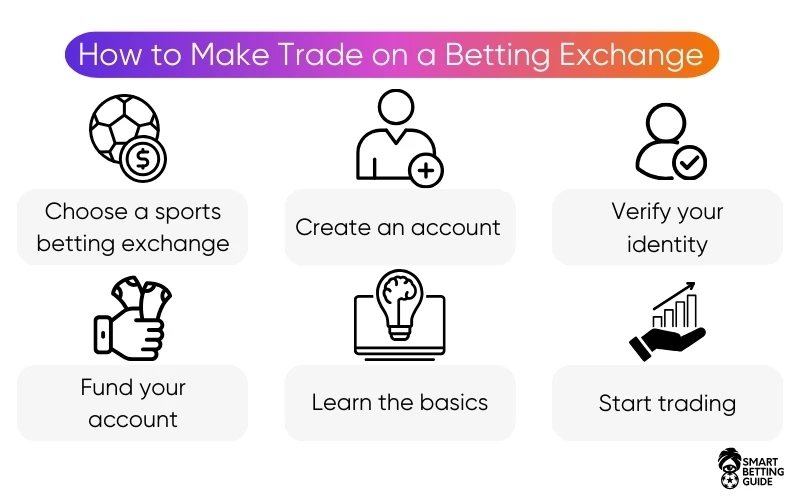
- Choose a sports betting exchange. You can choose any trustworthy exchange for sports betting that fits your preferences and style.
- Create an account. Sign up with your details, choose a secure password, and complete the basic contact verification steps, such as email and phone number verification.
- Verify your identity. Upload your ID and proof of address so the exchange can confirm your account and unlock full sport trading and withdrawal options.
- Fund your account. You can deposit a small amount to your account using various methods supported by the betting exchange, including credit cards, debit cards, bank transfers, and PayPal.
- Learn the basics. Ensure you understand backing, laying, liability, and how odds react to matched events. If possible, take a few minutes to explore the platform before trading.
- Start trading. Once your account is verified and funded, you can start sport trading. However, we recommend practicing in low-risk markets, observing how prices react to in-game events, and improving your strategy over time.
The Earning Potential of Sport Trades
How much you can earn from sport trading depends on the time you put into learning the markets and understanding how odds move. The more experience you gain, the easier it becomes to recognize price changes and identify profitable opportunities.
Odds can change very quickly — sometimes within seconds — or very slowly, over several minutes. Your profit comes from using trading techniques to react to these movements at the right moment.
Some days, the sports market is active and full of opportunities. Other days are quiet, which means your earnings will not always be the same.
For beginners starting with around $100, earning up to $40 per day on active match days is a realistic goal. With a slightly larger bankroll — around $200–$300 — the daily potential increases to $40–$80.
How Much Do You Need to Start Sports Trading?
Sport trading is flexible — you can trade with $50, $100, or $200 while you learn. What matters more is money management: placing a back bet with small stakes, keeping your liability low, and spreading your trades.
Sports trading for beginners, starting with $500 to $1,000, is more than enough to practice safely. As you improve, you can slowly increase your bankroll, but experience and discipline matter far more than the starting amount.
The goal at the beginning is to understand price movement and get comfortable managing positions. Most new to sport trading start with a small amount and focus on learning how odds move rather than trying to make large profits right away.
A simple trade can already show you how the system works.
For example, if it’s the 75th minute, the score is 1–0, and the odds for under 1.5 goals are around 2.00, a $100 trade at that moment could double your money if the score stays the same until the end.
Best Sports Trading Strategies
Sport trading becomes much easier when you follow a plan, instead of reacting emotionally to every price movement. When placing a back bet or sports trade, focus on stable markets and make informed, thought-through decisions.
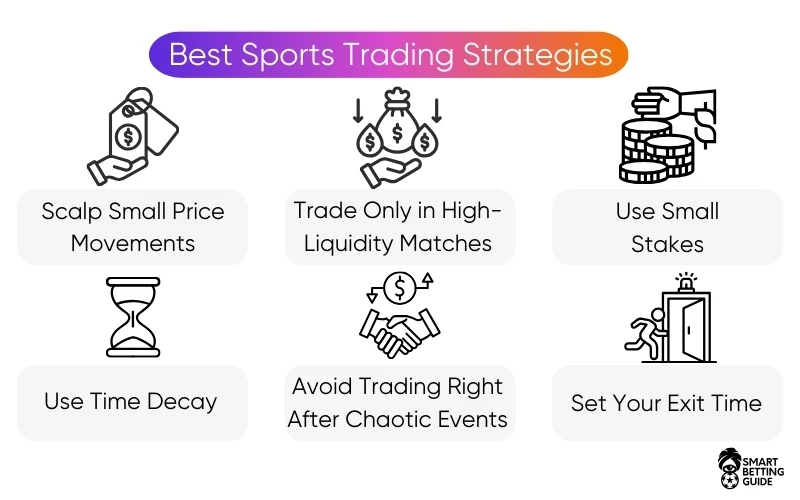
Scalp Small Price Movements in Active Markets
Take quick profits from tiny price movements (even $1–$5) in busy matches. Scalping works best when the game has clear momentum, and the prices move smoothly without big jumps.
Trade Only in High-Liquidity Matches
Stick to popular sports and big leagues, such as the Premier League, where the market reacts normally, and your trades get matched instantly. This avoids unpredictable price swings.
Use Small Stakes to Test Your Entries
Start with $2–$10 positions until you understand how odds react to pressure, possession, and dangerous attacks. This keeps learning cheap and safe.
Use Time Decay in the Late Minutes
In slow or low-scoring matches, the odds offered on Unders rise naturally as the time runs out. Sport trading from around the 65th to 80th minute often yields easy profits.
Avoid Trading Right After Chaotic Events
Right after a goal, red card, or VAR check, the odds jump in random directions. Waiting 20–30 seconds avoids bad entries.
Set Your Exit Before Entering the Trade
Know the exact profit you want and the maximum loss you accept before you place a bet. This prevents emotional decisions mid-match.
Sports Trading Tips & Strategies for Different Sports
Different sports create different price movements, so the best trading approach often depends on the game you’re following.
The table below provides simple and practical strategies, along with explanations, for some of the most popular sports.
| Football | |
| Lay the Draw (LTD) | You trade against the match ending in a draw, usually expecting one team to score. |
| Lay Correct Score | You bet against a specific final score and profit if the score changes in your favor. |
| Lay Big Favourites or Underdogs | You trade against heavily favoured or unlikely teams when the price seems too short. |
| Lay 0–0 Scoreline | You bet against the match finishing 0–0, taking advantage of any goal. |
| Horse Racing | |
| Scalping Before the Start | Make small, quick profits by trading horse racing odds movements before the start of the race. |
| Lay the Favourite | You trade against the most favoured horse, expecting the price to drift. |
| Lay Front Runners | Bet against horses that start fast but often fade later. |
| Swing Trade Pre-Race | Look for larger, slower price swings—the opposite of scalping—before the start to achieve higher profits. |
| Tennis | |
| Back the Server | Bet on the player who is serving, as servers typically maintain their form. |
| Lay the Favourite | Trade against the favourite when their form or momentum drops. |
| Scalping the Server | Take small profits from stable server odds during routine service games. |
| Lay Low Prices | Trade against low-odds players who are struggling or losing momentum. |
How to Become a Good Sports Trader in Sports Betting?
Becoming a successful sports trader isn’t about being perfect — it’s about building responsible gaming habits and learning how markets react during real matches. With time, you start recognising patterns, spotting good moments to enter, and avoiding trades that don’t make sense.
- Focus on one sport — whether trading on exchanges or learning patterns — so you can understand how its games typically unfold and how the odds shift as the match progresses.
- Trade with a simple routine, not random guesses — the more consistent your approach, the easier it becomes to see what works.
- Keep your stakes small until you’re fully comfortable with your decisions; it’s easier to learn when you’re not stressed about the money.
- Use sports betting exchange platforms for sport trading and only turn to top sports bookmakers when a specific strategy suits their fixed-odds format.
How Behavioral Biases in Sports Trading Work
Your biggest challenge in sport trading is often not the market — it’s your own reactions. Emotions, past experiences, and pressure can push you into trades that make no sense.
The best traders learn to recognise these mental traps early, so they can avoid rushed decisions, stick to their plan, and keep their bankroll safe.
| Bias | What It Means | How It Affects Your Trading |
|---|---|---|
| Mental Accounting | Treating some bets as “different money” instead of seeing your bankroll as one pot. | You let winning bets run too long or close losing trades too early. |
| Overconfidence | Believing you’re more skilled than you actually are. | You take bigger risks, ignore your trading strategy, and enter too many trades. |
| Herd Behavior | Copying what most traders are doing because it feels safer. | You follow the market without checking the stats or the match situation. |
| Emotional Gap | Strong emotions—such as fear, excitement, and panic—are driving your decisions. | You tend to overreact to goals, pressure, or losses, and place rushed trades. |
| Anchoring | Fixating on the first price you saw or paid. | You hold bad positions just because you want the price to “come back.” |
| Self-Attribution | Taking credit for wins but blaming losses on luck. | You stop learning from mistakes and repeat the same errors. |
| Loss Aversion | Feeling losses more strongly than gains. | You avoid closing a losing bet or skipping good trades because of fear. |
Final Thoughts on Sport Trading
Sport trading gives you more control than regular betting, letting you make decisions throughout the match instead of waiting for the final score.
With the right approach and sports trading techniques, even small stakes can grow steadily as you learn how different markets behave. The main step is to stay disciplined, focus on one sport, and aim for consistent profits with simple strategies that match your experience level.
FAQ About Sport Trading
⭐ What is sport trading?
Trading in sports involves backing and laying outcomes on a sports betting exchange, where users trade directly with each other. Odds move with supply and demand, creating opportunities to profit from price changes.
⭐ Is sport trading profitable?
✅ Yes — sport trading can be very profitable, and sports bettors find it easier to earn consistently compared to traditional betting. However, there’s no guarantee, like in any betting activity.
⭐ What is the best sport to trade?
Football is generally considered the best sport to trade because it has the most liquidity, the most predictable price movements, and the most active markets. Other popular options include tennis and horse racing, but football remains the easiest place to start.
⭐ Can you make a living in sport trading?
Some people do make a living out of sport trading, but it involves real risk and requires strong knowledge, discipline, and experience with odds movement.
⭐ How do I become a successful sports trader?
Focus on one sport, learn its market patterns through a sport trading guide or structured learning, choose a trading style that suits you, and consider structured learning to improve faster.

Crypto and Sports Betting Expert