
Know Your Customer in Betting (KYC)
-
 Written by
Dalius Mikalauskas
Written by
Dalius Mikalauskas -
13 Aug 20255 min. read

Placing a bet online looks quick and easy, but behind the scenes, betting platforms are doing a lot more than just taking your money. To keep things fair, legal, and secure, they rely on strict identity checks known as Know Your Customer (KYC).
In this article, we discuss why that process matters more than you might think.
Table of content
Key Takeaways
- KYC is legally required in online betting to prevent fraud, money laundering, and underage gambling.
- The process verifies identity with ID, proof of address, payment details, and sometimes proof of funds.
- Benefits include safer accounts, faster withdrawals, and stronger player protection.
- Without KYC, users risk fraud, identity theft, and no legal protection; operators risk fines and license loss.
- KYC supports AML by confirming identities and monitoring suspicious financial activity.
How Does KYC Work in Sports Betting?
KYC, or Know Your Customer, is a legal requirement for all licensed sports betting sites. It helps protect users and companies by confirming the identity of every customer. This process stops fraud, money laundering, and underage gambling.
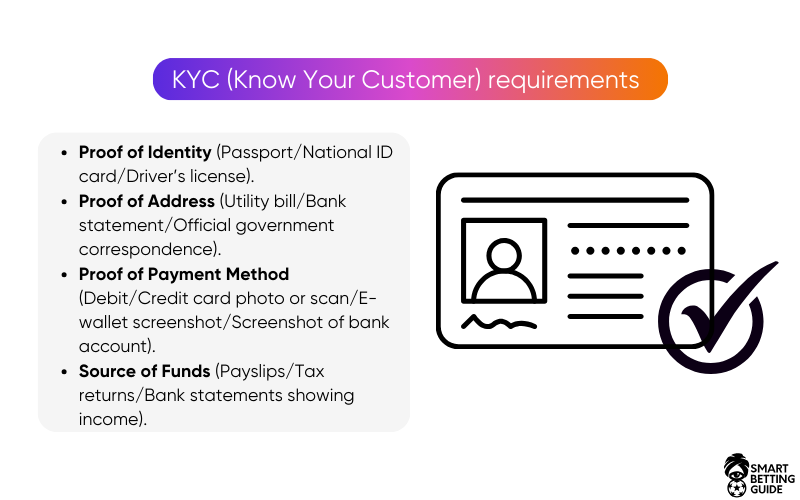
For the KYC process, the sports betting site will ask for personal details:
- You’ll need to provide your full name, date of birth, home address, and contact details such as your email and phone number.
- To verify your identity, the site will request a clear image of a government-issued ID, such as a passport, national identity card, or driver’s license.
- To confirm your residential address, you will be asked to submit a recent utility bill, bank statement, or official government letter that is no older than three months.
- The platform will ask for a screenshot or photo showing the account or card you used for payment method verification, proving that you are the rightful owner.
- Some betting sites also request a selfie and use facial recognition software to match your face with your ID and prevent identity fraud.
- In rare cases, you must show where your betting funds come from. This includes providing a payslip or bank transaction to comply with anti-money laundering regulations.
Benefits of KYC in Online Betting
KYC is more than just a legal step – it’s a safety net for both players and betting platforms. By verifying users, online casinos and bookmakers reduce fraud, protect data, and encourage responsible gambling.
The main benefits of KYC in sports betting include:
- KYC helps make sure that only the account owner can deposit or withdraw money.
- Most platforms now use secure, encrypted systems to verify users and protect personal data from hackers.
- It blocks fake users and prevents identity theft by checking personal documents.
- The process ensures that only people of legal age can access the platform.
- Verified users can use tools that support responsible gambling, like deposit limits.
- Once verified, users often get their withdrawals processed faster and more securely.
- KYC builds trust because players feel safer on platforms that verify all users.
- It helps betting companies follow the rules and keep their licenses.
Risks of Betting Without KYC
Betting on platforms that skip identity checks (KYC) can be risky. Without proper verification, both players and operators face serious problems, from fraud and legal trouble to underage gambling and loss of license.
| Risk | What Can Happen |
|---|---|
| Fraud and Identity Theft | Accounts can be stolen or misused without proof of identity. |
| No Legal Protection | Players can lose money with no legal way to recover it. |
| Underage Gambling | Sites can’t verify age, putting minors at serious risk. |
| Regulatory Penalties | Operators can face fines or lose their licenses for skipping KYC. |
| Money Laundering | Criminals can use platforms to move illegal money if checks are missing. |
When platforms follow KYC rules, they protect players and keep the betting space safe. However, if they don’t, the consequences are severe, both for users who lose trust and money and for companies that face legal action or shutdown.
How Do KYC and AML Work Together in Online Betting?
In online sports betting, KYC and AML (Anti-Money Laundering) are the two processes that work together to keep platforms secure and legally compliant. KYC verifies who a player is, while AML focuses on monitoring the flow of money and identifying suspicious activity.
KYC starts by collecting information such as a user’s name, age, address, and payment method. Once verified, the platform can use AML tools to watch for risky patterns. These include sudden large deposits, use of multiple accounts, or unusual withdrawal behavior. Platforms that ignore these checks risk legal trouble, fines, and loss of their license.
The main ways KYC supports AML:
- KYC confirms player identity before they can gamble.
- It creates a verified user profile for behavior tracking.
- It blocks fake IDs and prevents account fraud.
- KYC ensures only legal and traceable payments are used.
- It enables fast response to signs of suspicious activity.
Having a strong KYC process makes AML systems much more effective. But that’s not all. Betting platforms must also follow best practices, like updating their monitoring tools, training staff, and keeping records for audits.
KYC in Betting Bottom Line
KYC is more than just a formality in online sports betting — it’s the foundation of a safe, legal, and trustworthy environment. By verifying players’ identities and monitoring financial activity, betting platforms protect users from fraud, ensure responsible gambling, and maintain compliance with strict regulations.
For players, completing KYC may feel like an extra step, but it ultimately guarantees security, faster transactions, and peace of mind. In the long run, strong KYC and AML practices benefit everyone by keeping online betting fair, transparent, and sustainable.
FAQ On KYC in Betting
❓ What does KYC mean in gambling?
KYC stands for Know Your Customer, a process that verifies the identity of players on betting platforms to prevent fraud and ensure legal compliance
❓ How to pass KYC verification?
To pass KYC verification, you need to provide personal details and submit documents such as a photo ID, proof of address, and payment method.
❓ What is KYC risk?
KYC risk refers to the potential for fraud, identity theft, and legal issues that arise when identity checks are not conducted properly.
❓ Is no KYC legal?
❌ No, operating without KYC checks is illegal for licensed betting platforms and leads to severe penalties.
❓ What is an example of a KYC?
An example of KYC is submitting a government-issued ID and a recent utility bill to verify your identity and address.
❓ Is KYC verification safe?
✅ Yes, KYC verification is safe, as most platforms use secure, encrypted systems to protect your data.
❓ What happens if KYC fails?
If KYC fails, the user is unable to withdraw funds, and their account can be restricted or closed.

Crypto and Sports Betting Expert