Handicap Betting Explained 2026
-
 Dalius Mikalauskas
 -
06 Nov 202513 min. read

Handicap betting is what keeps a mismatch from feeling pointless. By giving one team a head start or making the other chase a bigger win, it turns a predictable result into something you can actually bet on.
Now, we’ll go through how handicaps work, the versions you’ll encounter, and the situations where they fit best.
Table of content
Key Takeaways
- Handicap betting make uneven games fairer to bet on.
- European handicaps use whole numbers and allow a draw.
- Asian handicaps remove the draw and use half or quarter goals.
- No-Draw handicap is separate bet type.
- Odds change with injuries, weather, and motivation.
- Handicaps give better odds when favorites are too strong.
What is Handicap Betting?
To define handicap betting simply: it’s betting that gives one team a virtual advantage or disadvantage before the match starts.
Handicap betting makes one-sided games more balanced by giving the weaker team a head start and the favorite a disadvantage. Instead of betting only on the real score, the result is adjusted by the chosen handicap, which often gives better odds than standard 1X2 markets.
In football, a favorite with a handicap of -1.5 must win by 2 goals for your bet to succeed. This is a common example of handicap in betting that shows how the system works. Backing the underdog at +2 means they can lose by one, draw, or win, and the bet still pays.
Handicaps are shown as plus or minus numbers, such as -1, -1.5, +1, or +2, and the adjustment is applied to the final score after the match. These lines are offered both before the start of a game and during live betting.
The system originated in horse racing, where stronger horses carried extra weight, and later expanded into football, basketball, hockey, and other sports. Today, it’s standard in most bookmakers, with both Asian and European versions giving bettors different ways to cover scorelines and manage risk.
Why Use Handicap Betting?
Handicap betting gives bettors options in games where the standard betting odds from traditional markets don’t offer much value. If a heavy favorite is priced too low, a handicap can increase the return without altering the likely outcome.
In cup ties, where professionals meet amateurs, handicaps stop the odds from being one-sided and give more betting choices. They are also helpful at the end of the season, when some teams fight for points and others have nothing to play for.
Finally, handicaps can highlight value when statistics like goals scored or conceded reveal that the bookmaker’s line is off.
Handicap Betting Benefits for Bettors
Here are some handicap betting benefits for bettors.
- Improve odds when favorites are too short to back in the regular market.
- Make one-sided games worth betting on by adding more options.
- Allow flexible strategies for betting, such as covering both teams or using handicaps to reduce risk.
Handicap Betting Benefits for Bookmakers
Here are some handicap betting benefits for bookmakers.
- Balance out mismatched games to spread betting more evenly.
- Bring in more bets since players see fairer and more attractive odds.
- Improve liquidity because action comes in on both sides of the line.
- Keep customers engaged in matches that might otherwise have little betting interest.
How Does Handicap Betting Work?
The process is settled in a few steps that determine whether you win your bet or lose your bet.
- First, you choose the sports betting handicap line, check the odds, and place your stake.
- Once the match starts, you can follow the score and compare it to the line you backed.
- The outcome is only decided after the game ends, when the handicap is applied to the result.
That adjusted score shows whether your bet wins, loses, or is refunded.
Take Manchester City (-2) against Norwich (+2). If City wins 3–0, the -2 bet would be paid as a win once the handicap has been applied to the final result. A 2–0 result cancels the bet, and your stake is returned. If the score ends 1–0, the -2 bet loses.
The same match can give different results depending on the handicap, which is why it changes how bettors read the scoreline.
The principle is easier to picture with horse racing. A stronger horse can carry extra weight, while another gets a head start over distance. The race is judged after those adjustments, not just on who finishes first.
Handicap betting works in the same way — finishing positions are rebalanced, which helps make uneven games fairer and gives bettors more realistic options.
Types of Handicap Betting Markets
There isn’t just one kind of handicap bet. Best bookmakers offer several variations, each with its own rules, outcomes, and risk level. Some keep the draw as an option, others remove it completely, and a few even split your stake across 2 lines.
Here you can see 3 different handicap betting markets:
| Bet Type | Outcomes Available | Key Feature | When It’s Most Useful |
|---|---|---|---|
| Standard (European) | Win / Draw / Lose | Uses whole numbers; the draw option stays | Simple betting for bettors wanting 3 results, fixed lines |
| Asian Handicap | Win / Lose (sometimes Push) | Removes draw, includes half & quarter lines, stake can be refunded | Flexible risk control is common in tight matches |
| No-Draw Handicap | Win / Stake Refunded on Draw | Same as “Draw No Bet” — push if a draw | Safer option when you back one team to win |
Standard Handicap (European Handicap)
The Standard, or European handicap is the most straightforward version. It always uses whole numbers and, unlike Asian handicap, it leaves you with 3 possible outcomes: win, draw, or lose after the handicap is applied.
Asian Handicap
The handicap meaning in Asian betting has several significant differences compared to the European version. The most important one is that Asian handicap usually removes the draw option, giving one outcome an advantage through fractional lines. You’re left with only two results: either your bet wins or it loses.
No-Draw Handicap
Also known as “Asian Handicap 0,” the No-Draw handicap bet is straightforward. You pick a side to win, but if the game ends in a tie, your stake is refunded. It’s a safer bet when you’re fairly confident one team is stronger, but want protection if it ends in a tie.
Many bettors use this as a replacement for the “draw no bet” market because the idea is the same.
Handicap Betting in Different Sports
Handicap betting isn’t limited to football. Bookmakers use it across many sports to balance games and give bettors more ways to play than just picking a winner.
Each sport has its own style of handicaps — from goals and corners in football, to spreads in basketball, or even maps in esports.
| Sport | Common Handicap Types | Key Feature | When It’s Most Useful |
|---|---|---|---|
| Football | Goals, corners, cards | 3 main markets, influenced by league styles | When predicting margins or patterns (e.g., defensive vs. attacking leagues) |
| Basketball | Point spreads, quarter/half lines | Standard NBA spreads, live/period betting | High-scoring games where spreads matter more than just winners |
| Rugby | Points and try-based handicaps | Large spreads are common, Union vs. League styles | Matches with heavy favorites and weather factors |
| Tennis | Games or sets handicaps | Surface and match length matter | When players are unevenly matched in best-of-3 or 5 |
| Horse Racing | Weight, distance, class handicaps | Levels the field in competitive races | Useful in large racing fields |
| NFL | Point spreads, teaser bets | Key numbers (3, 7) heavily impact outcomes | Games where touchdowns dictate margins |
| Esports | Map, round, kill handicaps | Game-specific formats (LoL, CS, Dota, etc.) | When predicting map dominance or kill totals |
| Cricket | Runs, wickets, format-specific lines | Different rules in T20, ODI, Test matches | Matches where conditions affect scoring heavily |
Football
Handicap betting in football goes beyond simple goal lines. The most common options are goal, corner, and card handicaps, each of which is useful in different situations.
Goal lines like -1 or +1.5 are the most common, giving one team a head start or increasing the favorite’s win margin. Corner handicaps are used when one side is likely to push forward and win more corners, even if they don’t score many goals. Card handicaps are based on yellow and red cards and work best in derby games, where the play is more physical.
Different leagues influence these bets in their own way. The Premier League often has close matches, so smaller goal lines are popular.
The Bundesliga typically yields more goals, which means larger handicaps. Serie A is more defensive, so lower goal lines and card betting often make more sense in this league.
A Champions League game is a good example of how these factors come together. If Manchester City is set at -2 against a weaker opponent, the line looks straightforward, but team rotation or defensive tactics from the other side can make it risky.
In that case, a smaller handicap or even switching to a corner market could be the smarter option.
Basketball
Handicap betting in basketball primarily revolves around the point spread. In the NBA, spreads often range from -6.5 to -12.5, depending on the strength of one team compared to the other.
College basketball is a bit different — the games are lower scoring and upsets happen more often, so the lines are usually tighter.
It’s also common to bet on quarters or halves instead of the whole game. Some teams start strong in the first half but fade later, so betting just one period can be a smart move.
Live betting is also popular, as basketball is a sport where momentum can shift quickly.
Since games have so many points, larger handicaps are normal. Double-digit spreads happen all the time, and you always need to remember that overtime counts toward handicap bets. A late run in overtime can completely change the outcome.
For example, if the Bucks are -9.5 against the Pistons and win by 10, the spread is covered. But if they only win by 8, the bet loses.
Rugby
Handicap betting in rugby often focuses on points handicaps. Rugby League usually has higher scores, so the lines are bigger compared to Rugby Union, where games can be tighter.
It’s common to see ranges of -12 to -20 in international matches when strong teams face weaker ones.
There are also try-based handicaps, where bets are settled on the number of tries scored instead of total points. These markets are useful in one-sided games, as they can offer better value than backing a team on the main point spread.
Additionally, international tournaments, such as the Six Nations, provide good examples of how conditions matter. England might be given a -14 line against Italy, but if the match is played in heavy rain or strong wind, scoring usually drops, and suddenly Italy +14 becomes the safer option.
Tennis
In tennis, handicaps are typically placed based on either the number of games or sets a player wins. With a game’s handicap, the bookmaker adjusts the final total of games won.
For example, if Djokovic is -5.5, he needs to win at least 6 more games than his opponent.
These lines often depend on the format: best-of-3 matches usually create smaller margins, while best-of-5 matches in Grand Slams leave more room for one player to pull ahead.
Court surfaces also play a role — clay tends to produce longer rallies and closer scores, which can make covering big handicaps harder.
A set’s handicap works similarly but focuses only on sets won. An underdog with a +2 set line in a Slam can still lose the match, but win the bet if they manage to take a set or two. In shorter best-of-3 games, though, there’s less time, so the risk is higher.
These factors come together in real scenarios. Take Djokovic against a qualifier in a Grand Slam: a -2.5 sets handicap would mean backing him to win in straight sets.
On faster courts, this is often realistic, but on clay, the slower pace gives underdogs more chances to stretch the match, making a +1.5 sets bet on the outsider more appealing.
Horse Racing
In horse racing, handicaps are used to make races fairer. The most common is weight handicapping, where stronger horses carry extra weight.
There are also distance handicaps, which adjust based on how horses perform over different race lengths, and class handicapping, which matches horses from different competition levels.
American Football (NFL)
In the NFL, handicaps come through the point spread. Teams receive points added or deducted before the game starts to even things out.
The numbers 3 and 7 are especially important because a field goal or touchdown decides many games. Some bettors also use teaser bets, which let them move the spread in their favor across several games, though the payout is smaller.
Esports
In esports betting, handicaps depend on the game. They can be based on maps, rounds, or kills.
In CS2, for example, a -1.5 map handicap in a best-of-3 means the team must win 2–0. Kill handicaps are common in CS2 and Dota, while League of Legends often uses objectives.
Cricket
Cricket uses different handicap betting types depending on the format. Run handicaps adjust totals by runs, while wicket handicaps are based on bowlers taking wickets.
Match format matters significantly: T20 games typically have small margins due to their brevity, whereas ODI and Test matches can have much larger spreads as scoring gaps accumulate over time.
How Handicap Sports Betting Odds Are Calculated
Handicap betting odds aren’t just guessed. Bookmakers set the first line using stats, ratings, and past results.
Here’s how odds are connected explicitly to handicaps:
- Handicap odds indicate the likelihood of a particular outcome.
- Bookmakers add a margin, known as juice or vig.
- Removing that margin gives the “fair” odds.
- -110 is the common example in US markets.
Several outside factors also affect handicaps. Team injuries, bad weather, or strong home advantage can move a line in minutes. Motivation late in the season or past matchups between the same sides also play a big part.
The display of odds depends on the format. Decimal odds tell you exactly how much you win for every unit staked. Fractional odds indicate the profit in relation to your stake. American odds use plus or minus numbers to mark underdogs and favorites.
Handicaps alter these payouts by adjusting the likelihood of the outcome. To see if the bet is worth it, bettors use the break-even percentage — the win rate needed to stay profitable at those odds.
Tips for Handicap Betting Strategy
Handicap betting can be profitable, but only if you approach it with a plan. Many bettors lose money by chasing odds, ignoring team news, or failing to understand how the lines work.
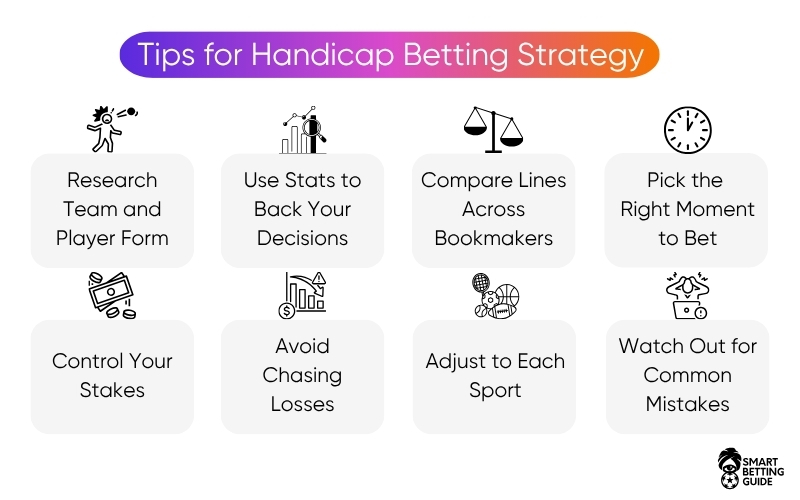
Research Team and Player Form
Look beyond the last result. Check recent performance, home vs. away records, and head-to-head history. A team that struggles away from home might not be able to cover even a small handicap.
Use Stats to Back Your Decisions
Numbers like expected goals (xG) in football or pace and efficiency stats in basketball help you see past the scoreline. They show whether a team is creating chances or just getting lucky.
Compare Lines Across Bookmakers
Never settle for the first odds you see. A -1.5 at one bookmaker might be -1.25 at another, giving you more protection. Line shopping can make a big difference over time.
Pick the Right Moment to Bet
If you bet early, you can catch softer lines before they move. If you wait until late, you can use injury or lineup news to your advantage. Watch line movements — sudden shifts often show where the smart choices are made.
Control Your Stakes
Decide how much of your bankroll you’re willing to risk on each bet and stick to it. Flat stakes or small percentages are safer than randomly increasing bets after a loss.
Avoid Chasing Losses
Don’t jump on bigger handicaps or build risky accumulators just to win back money. This usually leads to even bigger losses. Set a stop point for yourself.
Adjust to Each Sport
In football, team style and motivation matter more than form alone. In basketball, consider pace and rest days. In tennis, surface and player fitness can decide whether a handicap is realistic. Also, always factor in weather and venue conditions before betting.
Watch Out for Common Mistakes
Don’t confuse different handicap betting types, and always read the bookmaker’s rules since they vary by market. Ignoring team news or betting emotionally are 2 of the quickest ways to lose.
Handicap Betting Summary
Handicap betting balances uneven matches by giving one team a virtual advantage and the other a disadvantage, turning predictable games into fairer betting opportunities.
The main types — European, Asian, and No-Draw handicaps — differ in structure and risk, with European keeping the draw and Asian removing it for more flexibility.
Used in football, basketball, tennis, and other sports, handicap betting helps bettors find better value and smarter angles than traditional 1X2 markets. Understanding margins, team form, and line movements is key to using handicaps effectively and improving long-term results.
FAQ About Handicap Betting
⭐ What is a handicap in betting?
Handicap in betting definition means making uneven matches fairer by giving the weaker team a head start and the stronger team a disadvantage. The meaning of handicap betting is to adjust the final result for betting purposes, creating more balanced odds.”
⭐ How do handicap betting odds work?
Handicaps in betting are shown as plus or minus numbers, such as -1, -1.5, or +2. The adjustment is applied after the game, and the odds usually offer better value than standard 1X2 bets.
⭐ What is the difference between Asian and European handicap?
European handicap betting uses whole numbers and includes a draw option, while Asian handicap betting removes the draw and adds half or quarter lines for more flexible outcomes.
⭐ Can you use handicap betting in sports other than football?
✅ Yes. Handicap betting is common in basketball, hockey, rugby, tennis, and even horse racing, as well as in eSports, with each sport adjusting its handicap system to fit its specific rules.
⭐ What happens if the match ends in a draw with a handicap?
It depends on the type. In European handicap, a draw is a possible result. In Asian handicap, some lines refund your stake (push), while others remove the draw option completely.
⭐ Is handicap betting better than 1X2 betting?
It can be. Handicap betting often give better odds in one-sided games and open more betting options, especially when the favorite is too short to back directly.
⭐ Where did handicap betting start?
It first appeared in horse racing, where stronger horses carried extra weight, before spreading into football, basketball, and other sports.
⭐ Can you place handicap bets live during a match?
✅ Yes. Bookmakers offer handicaps both before the start of the game and in-play, with live lines adjusting as the game unfolds.

Crypto and Sports Betting Expert