
How to Play Blackjack: The Card Game Rules Explained
Learning how to play blackjack the card game means learning the blackjack rules that decide every hand: beat the dealer without going over 21. The game looks intimidating at a real table, with chips, hand signals, and a dealer moving fast.
The core rules are easy to learn, taking only a few minutes, though. This guide walks through every step, from placing your first bet to reading the values on the table, so you know exactly what to do when the dealer deals your first hand.
Table of content
- Key Takeaways
- The Objective of Blackjack
- Card Values in Blackjack
- How to Play Blackjack Step by Step
- Blackjack Payouts and Odds
- Basic Strategy Essentials
- Common Blackjack Mistakes to Avoid
- Where to Play Blackjack Online?
- Blackjack vs Other Card Games
- Responsible Gambling
- FAQ About How to Play Blackjack the Card Game
Key Takeaways
- The goal is a hand total closer to 21 than the dealer manages, without busting.
- Number cards count at face value, face cards count as 10, and an ace counts as 1 or 11.
- Every round starts with a bet, followed by two cards for each player and the dealer.
- Hit, stand, double down, or split are your four main decisions on any hand.
- A natural 21 (ace plus a 10-value card) usually pays 3:2 on your bet.
The Objective of Blackjack
The objective of the game is simple: build a hand worth more than what the dealer holds, without going over 21. That’s why this game of blackjack is often called “twenty-one” in casual conversation.
You are not competing against other players at the table. Every hand is a one-on-one contest between you and the dealer, even when four other people are sitting at the same table with their own bets in play.
Going over 21 is called a bust, and it means you lose the hand instantly, regardless of what the dealer ends up with. That single rule shapes almost every decision you will make during a round, from the first card onward.
The house always keeps a small mathematical edge in this game, usually somewhere between 0.5% and 2% depending on the table’s specific rules. Understanding the objective clearly is the first step toward keeping that edge as small as possible.
Rule variations like the number of decks in play, whether the dealer hits or stands on a soft 17, and whether doubling down is allowed after a split all shift that edge slightly. None of these variations change the basic objective, but they’re worth noticing before you choose which table to sit at.
[insert image of a blackjack table layout with player and dealer positions]
Card Values in Blackjack
Card values follow three simple groups once you memorize them. Number cards from 2 through 10 count at their printed value, so a 7 is worth 7 points and a 4 is worth 4 points.
Face cards, meaning jacks, queens, and kings, all count as 10 points. The ace is the only flexible card, since it can be counted as 11 or dropped to 1, whichever helps your hand more at that moment.
| Card | Value |
|---|---|
| 2 to 10 | Face value |
| Jack, Queen, King | 10 |
| Ace | 1 or 11 |
This flexibility creates what’s known as a “soft hand.” A hand like ace and 6 is called a soft 17, because that card can drop from 11 to 1 if you draw a card that would otherwise cause a bust.
A “hard hand” has no ace, or one that can only count as 1 without busting. A hand like 10 and 7 is a hard 17, since there’s no flexibility left to adjust the total. Knowing this difference matters a lot once you start making hit or stand decisions later in the round.
Here’s a quick worked example. Say you’re dealt a 9 and a queen, which totals 19 points right away, since the queen counts as 10. Now say your next hand is an ace and a 5, which totals either 6 or 16, and you’d count it as 16 since that’s the higher useful value without busting.
Suits don’t matter at all in this game, unlike in poker or bridge. Different blackjack variants, like European and American blackjack, keep this rule the same even as other details shift. A 7 of hearts and a 7 of spades carry exactly the same value at the table, which simplifies the math considerably compared to other card games.
How to Play Blackjack Step by Step
Playing blackjack follows a fixed sequence at every table, whether you’re at a physical casino or playing online. Each round moves through the same four stages in order.
Placing Your Bet
Every round starts with a wager placed in the circle in front of your seat. You need to place your chips before any cards are dealt, since wagers can’t be adjusted once the round begins.
Table minimums and maximums vary by casino and even by individual table within the same casino. A sign at the table usually shows the minimum wager, commonly $5, $10, or $25 depending on the venue.
Chips come in different colors representing different denominations, so it helps to check the chip values with the dealer if you’re new to a specific table. Once all bets are placed, the dealer moves on to dealing the cards.
Dealing the Cards
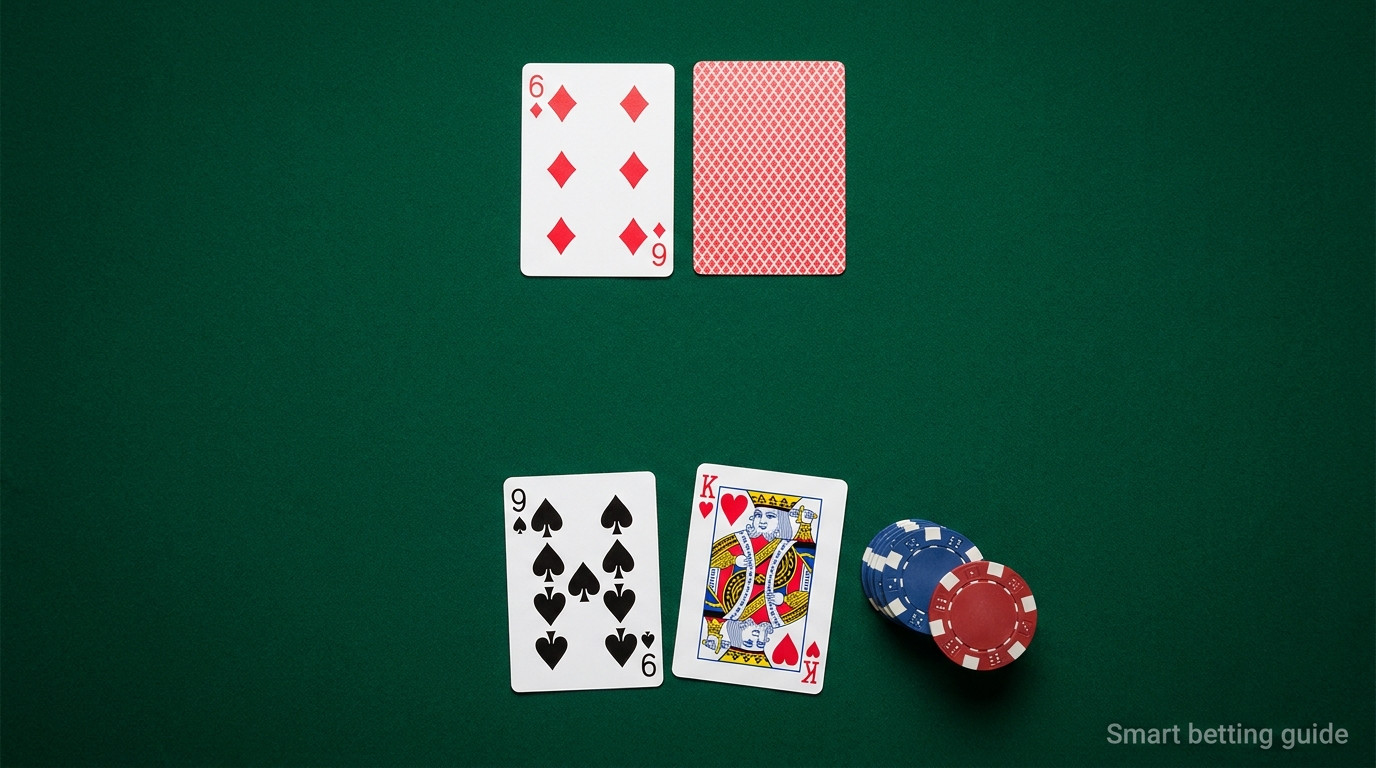
The dealer gives 2 cards to each player and 2 cards to themselves, moving around the table in order. Both of your cards are usually dealt face up, so you can see your total immediately, before the dealer moves on to the next player.
One of the two cards dealt to the dealer stays face down until the end of the round, and this hidden card is called the hole card. The other card the dealer holds, the one you can see, is called the up card, and it heavily influences every decision you make on your own hand.
Some tables use a single deck, while others use a shoe holding several shuffled packs together. A bigger shoe slightly changes the odds, though the core rules stay identical either way.
Most physical tables seat between five and seven players at once, arranged in a semicircle around the dealer. Online tables often seat fewer players, and some formats let you play entirely alone against the dealer with no wait between hands.
Hit, Stand, or Bust
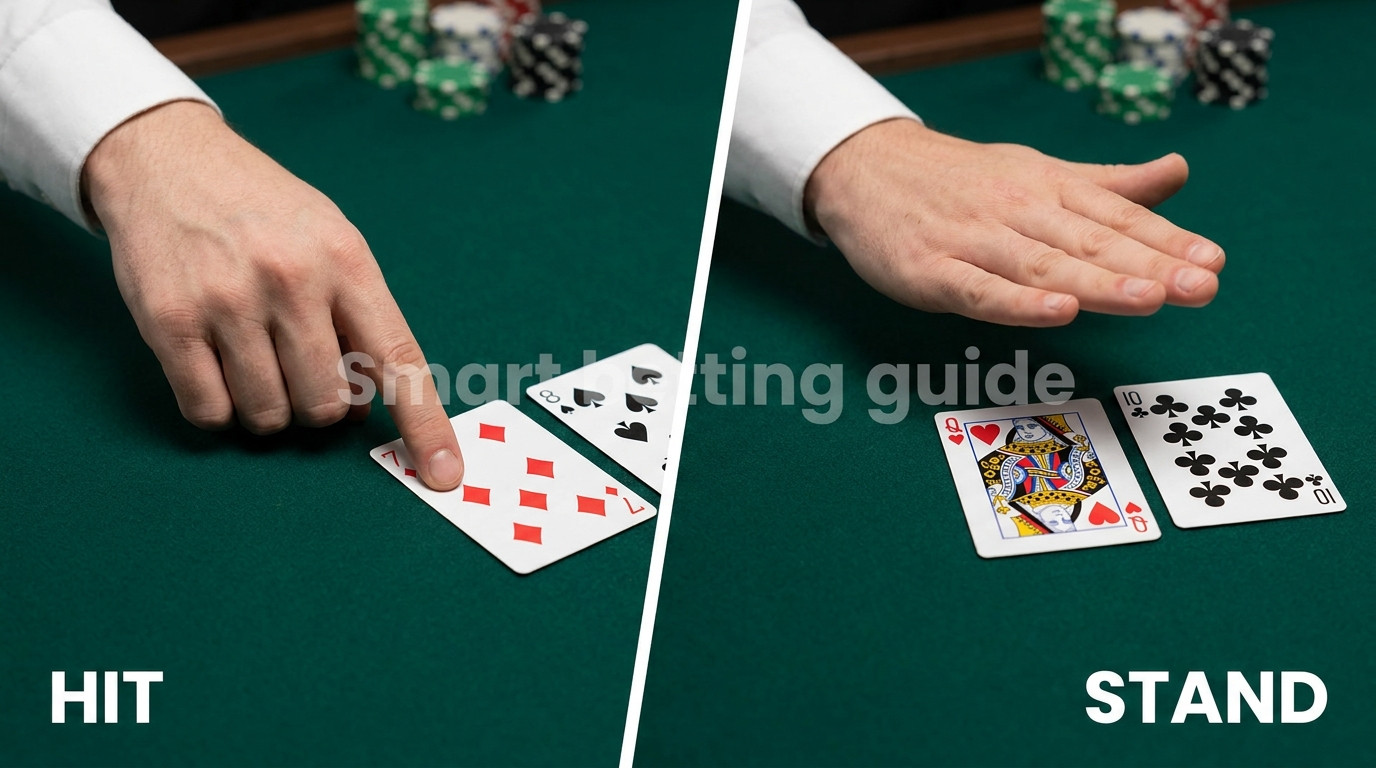
Once you see your hand, you choose to hit or stand based on your total and the up card the dealer shows. Hitting means taking another card, while standing means keeping your current total and ending your turn.
You can keep hitting as many times as you want, drawing additional cards one at a time. Going over 21 at any point ends your turn immediately, and that hand becomes a bust regardless of what happens next.
For example, if your first two cards total 12 and the dealer shows a weak card like a 4, basic strategy usually says to stand. If the dealer shows a strong card like a 10, the same 12 usually calls for a hit instead, since the dealer is more likely to end up with a strong hand.
Picture a full round to see how this plays out. You’re dealt a 6 and a 5 for a total of 11, and the dealer shows a 9 as their up card. Hitting is the clear choice here, since 11 can’t bust on the next card and a 10-value card would give you a strong 21.
After every player finishes hitting or standing, the dealer reveals their hole card and plays their own hand. Dealers usually follow a fixed rule, standing on 17 or higher and hitting on anything lower, with no room for personal judgment calls.
At a physical table, decisions are made with hand signals instead of words, since every table is recorded on camera for security. Tapping the table means hit, while waving a flat hand over your cards means stand.
Doubling Down, Splitting & Insurance
Doubling down lets you double your original bet in exchange for exactly one more card, after which your turn ends automatically. Most players use this option on strong starting totals like 10 or 11, where one good card often produces a very strong final hand.
Splitting is only available when your first two cards match in value, such as two eights or two aces. You separate them into two hands, each with its own bet equal to the original wager, and play them out independently against the same dealer hand.
Insurance is a side bet that only pays out on a dealer blackjack, offered when the up card the dealer shows is an ace. It pays 2 to 1, but only if the dealer has a blackjack in the hole, and most strategy charts recommend skipping this bet entirely since it favors the house over the long run.
Some tables also allow re-splitting, meaning you can split again if you draw a third matching card after an initial split. Rules on re-splitting and doubling after a split vary by casino, so it helps to check the table’s printed rules before your first hand.
Blackjack Payouts and Odds
Payouts depend on the strength of your final hand compared to what the dealer ends up holding. A natural blackjack, meaning an ace plus a 10-value card on your first two cards, is the strongest possible result and pays out at a better rate than a regular win.
| Outcome | Typical Payout |
|---|---|
| Natural 21 (ace + 10-value card) | 3:2 |
| Regular win | 1:1 |
| Insurance win | 2:1 |
| Push (tie with dealer) | Bet returned |
A push happens when your final total ties the total the dealer ends up with, and in that case your original bet simply comes back to you. No one wins or loses on a push, and the round is treated as a draw.
Some tables offer a reduced payout of 6 to 5 instead of the standard 3 to 2, meaning you get paid 3 to 2 only at the better tables. This small difference significantly increases the house edge over time, so it’s worth checking the table rules before you sit down and place a wager.
Many casinos also offer side bets like Perfect Pairs or 21+3, placed separately from your main wager. These side bets usually carry a much higher house edge than the main game, so they’re worth treating as pure entertainment rather than a serious part of your strategy.
Basic Strategy Essentials
This kind of strategy lowers the house edge close to its theoretical minimum, but it never removes that edge completely. The house always keeps a small mathematical advantage over time, no matter how precisely you play every hand.
A few rules cover most situations you’ll face at the table:
- Always hit on a hard total of 8 or lower, since there’s no risk of busting.
- Stand on a hard total of 17 or higher, since hitting rarely improves the outcome.
- Double down on a total of 10 or 11 when the dealer shows a weak up card like 4, 5, or 6.
- Split aces and eights almost every time, but avoid splitting 10s, since that pair already performs well as a single hand.
These four guidelines cover a large share of hands you’ll see in a normal session at the table. They come from a full strategy chart, which lists the mathematically correct move for every possible hand against every up card the dealer might show.
The mathematician Edward Thorp published the original calculations behind this kind of strategy back in the 1960s. His work showed that a disciplined, math-based approach could shift the odds meaningfully closer to even, without needing to memorize an entire deck.
[Editorial note: link here once the dedicated strategy chart article is published, internal link placeholder, no live URL yet.]
Common Blackjack Mistakes to Avoid
New players tend to repeat the same few mistakes at the table, often without realizing it. Avoiding these habits will improve your results more than any lucky streak ever could.
- Taking insurance on every hand where the dealer shows an ace, even though the math rarely favors it.
- Standing on a soft hand like ace-6 instead of hitting, since that flexible card makes hitting nearly risk-free.
- Splitting 10-value cards like a king and a queen, which breaks up an already strong winning hand into two weaker ones.
- Chasing losses by increasing bet size after a bad round, hoping to win back money quickly.
- Playing a table with a 6:5 blackjack payout without noticing the worse odds.
Each of these mistakes trades a small short-term comfort for a worse long-term result. Sticking to the strategy chart avoids all five of them, even when instinct suggests a different move.
Practicing with a free online table before betting real money helps these habits stick. Most beginners need a few dozen hands before the correct decisions start feeling automatic instead of forced.
Where to Play Blackjack Online?
A few factors matter more than the rest when choosing where to play online. A valid gaming license from a recognized regulator confirms the site operates under fair, audited conditions.
Live dealer tables give a closer feel to a physical casino, streaming a real dealer instead of a computer-generated one. Table limits also vary widely between sites, so it helps to compare minimum bets if you’re starting with a small bankroll.
[Placeholder: insert recommended casino brand, shortcode, and 2-3 sentences on why it suits beginners learning to play.]
single-casino name=”Flagman” display-type=”ratingwide”
Blackjack vs Other Card Games
Blackjack and poker are both played with a standard deck, but they work in very different ways underneath. Blackjack pits you against the dealer alone, while poker pits you against other players sitting at the same table.
| Feature | Blackjack | Poker |
|---|---|---|
| Opponent | Dealer | Other players |
| Skill factor | Basic strategy, low variance | Reading opponents, high variance |
| Goal | Beat dealer’s hand value | Win the pot with best hand or bluff |
Blackjack has a fixed mathematically correct answer for almost every hand you’ll see. Poker rewards a completely different skill set, one built on reading other players and managing a much wider range of possible outcomes.
If you prefer a game with a clear correct answer for every decision, this one fits better than poker. If you enjoy reading people and bluffing your way to a win, poker rewards that skill far more directly.
Session length also differs quite a bit between the two games. A round at the table usually takes under a minute, while a single poker hand can stretch on for several minutes depending on how many players stay in.
Responsible Gambling
Blackjack should stay entertainment, never a way to make consistent money. Set a budget before you sit down at the table, and stop once you reach that limit, whether you’re winning or losing.
Age restrictions apply at every licensed casino, both online and offline. In most jurisdictions, you must be at least 18 or 21 years old to play, depending on local law and the specific casino’s own policy.
If gambling ever stops feeling fun or starts affecting your daily life, take a break from the tables. Consider reaching out to a responsible gambling organization in your region for confidential support.
Common warning signs include betting more than you planned, feeling anxious between sessions, or borrowing money to keep playing. Recognizing these signs early makes it much easier to step back before they become a bigger problem.
Most licensed online casinos offer built-in tools like deposit limits, session timers, and self-exclusion options. Setting these limits before your first session, rather than after a rough one, makes them far easier to stick to.
FAQ About How to Play Blackjack the Card Game
Do You Hit on 16 or 17?
You should hit on a hard 16 when the dealer shows a strong up card like 7 or higher. Standing is usually correct on a hard 17, unless it’s a soft 17 and the specific table rules say the dealer must hit as well.
What Is the Golden Rule of Blackjack?
The golden rule is to follow the strategy chart consistently, rather than relying on gut feeling in the moment. This single habit has the biggest long-term impact on your results at the table.
How Much Do You Win if You Bet $1,000 on Blackjack?
A regular win on a $1,000 bet pays 1:1, so you’d win $1,000 on top of your original wager. A natural 21 on the same bet pays 3:2 instead, so you’d win $1,500 on the same size bet.
How Many Cards Are in a Blackjack Deck?
A standard deck has 52 cards, and most casinos deal from a shoe holding multiple decks shuffled together. Six or eight decks per shoe is common in physical casinos, while online tables often use continuous shuffling machines instead.
Can You Count Cards in Blackjack?
Card counting is a legal technique that tracks which cards remain in the shoe as the round progresses. Casinos discourage the practice and can ask a suspected counter to leave, even though the technique itself isn’t illegal under the law.
Is Blackjack Good for Beginners?
Yes, this is one of the more beginner-friendly casino games, since the rules are simple and one strategy chart covers nearly every situation. The house edge is also lower than in many other casino games once you stick to that strategy.
Does the Dealer Always Hit on 16?
Dealers must hit on any total of 16 or lower, following a fixed house rule with no personal judgment involved. Whether a dealer hits or stands on a soft 17 depends on the specific table’s printed rules, so it’s worth checking before you sit down.