How to Play Roulette: Beginner’s Guide for 2026
Roulette is a casino game where you bet on where a spinning ball will land. You place chips on numbers, colors, or groups on the table. The wheel spins. The ball drops. A number wins. This guide covers the four steps to play, the bet types, and the wheel variations you will see at casinos.
Table of content
- Key Takeaways
- How to Play Roulette in 4 Steps
- Basic Roulette Rules for Beginners
- How the Roulette Wheel Works
- Types of Roulette Bets
- Roulette Payouts and Odds
- Popular Roulette Betting Strategies
- Common Roulette Mistakes for Beginners to Avoid
- Essential Roulette Table Etiquette
- Where to Play Roulette Online
- Responsible betting in Roulette
- Frequently Asked Questions About Roulette
Key Takeaways
- Learning how to play roulette takes four steps: buy chips, bet, watch the spin, collect winnings
- Roulette rules give European wheels a lower 2.7% house edge than American wheels’ 5.26%
- Outside bets win more often but pay less; inside bets pay more but win less often
- Roulette odds never favor any betting strategy, including Martingale or Fibonacci, over time
- Responsible roulette gaming means setting a budget and checking table limits first
How to Play Roulette in 4 Steps
Playing roulette follows the same four-step pattern every time. You buy chips, place your bets, watch the wheel spin, then collect any winnings. Each step below explains what happens and what to do.
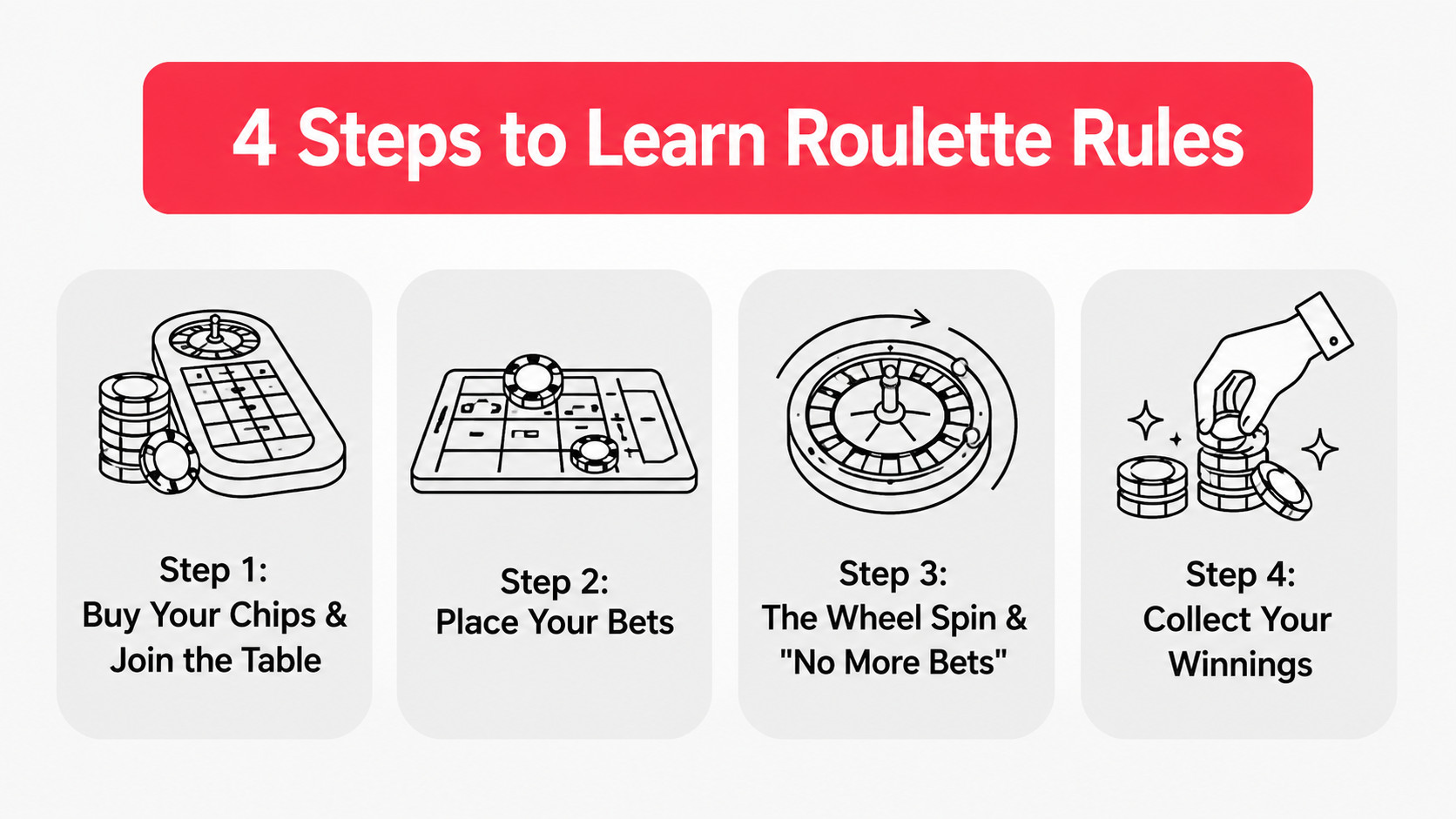
Step 1: Buy Your Chips & Join the Table
Join any open seat at an active roulette table before the next round of betting starts. Buy your chips directly from the dealer at the table, never from the main casino cashier. Tell the dealer exactly how much cash you want to convert into your own colored roulette chips.
The dealer gives you a unique chip color that belongs only to your seat at that table. This color system stops confusion when several players place bets on the exact same number. Chip value always depends on your buy-in amount, so confirm the exact value with the dealer before you bet.
Step 2: Place Your Bets
Place your bets only after the dealer clears the chips from the previous round off the table. Put your chips directly on the numbers, colors, or sections you want to back this round. Most roulette tables let you stack several different bets across the layout within the same betting round.
Inside bets sit on single numbers or small clusters of numbers near the center of the layout. Outside bets sit on bigger sections of the betting layout, such as red, black, odd, or even numbers. Mix inside and outside bets together on the same spin to balance your risk against your potential payout.
Step 3: The Wheel Spin & “No More Bets”
The dealer spins the roulette wheel and rolls a small white ball around its outer rim in the opposite direction. Betting stays open while the wheel spins and the ball is still moving fast around the track. The dealer calls out no more bets once the ball begins to slow down and lose speed.
No chips can move, get added, or get removed from the layout after that call happens. The ball eventually drops off the track and lands inside one numbered pocket on the wheel. That single pocket number becomes the official winning result for every bet placed by every player during the round in roulette games.
Step 4: Collect Your Winnings
The dealer places a small marker, called a dolly, directly on top of the winning number on the layout. Losing bets get swept off the table and cleared away right after the dolly gets placed. Winning bets stay exactly in place on the layout until the dealer pays each one out.
The dealer pays outside bets first, then works carefully through each inside bet one by one. Payouts for every winning bet get stacked directly next to your original chips, still sitting on the layout, as you learn how to play roulette. Collect your full stack of winning chips, then cash them all in at the table once you finish playing.
Basic Roulette Rules for Beginners
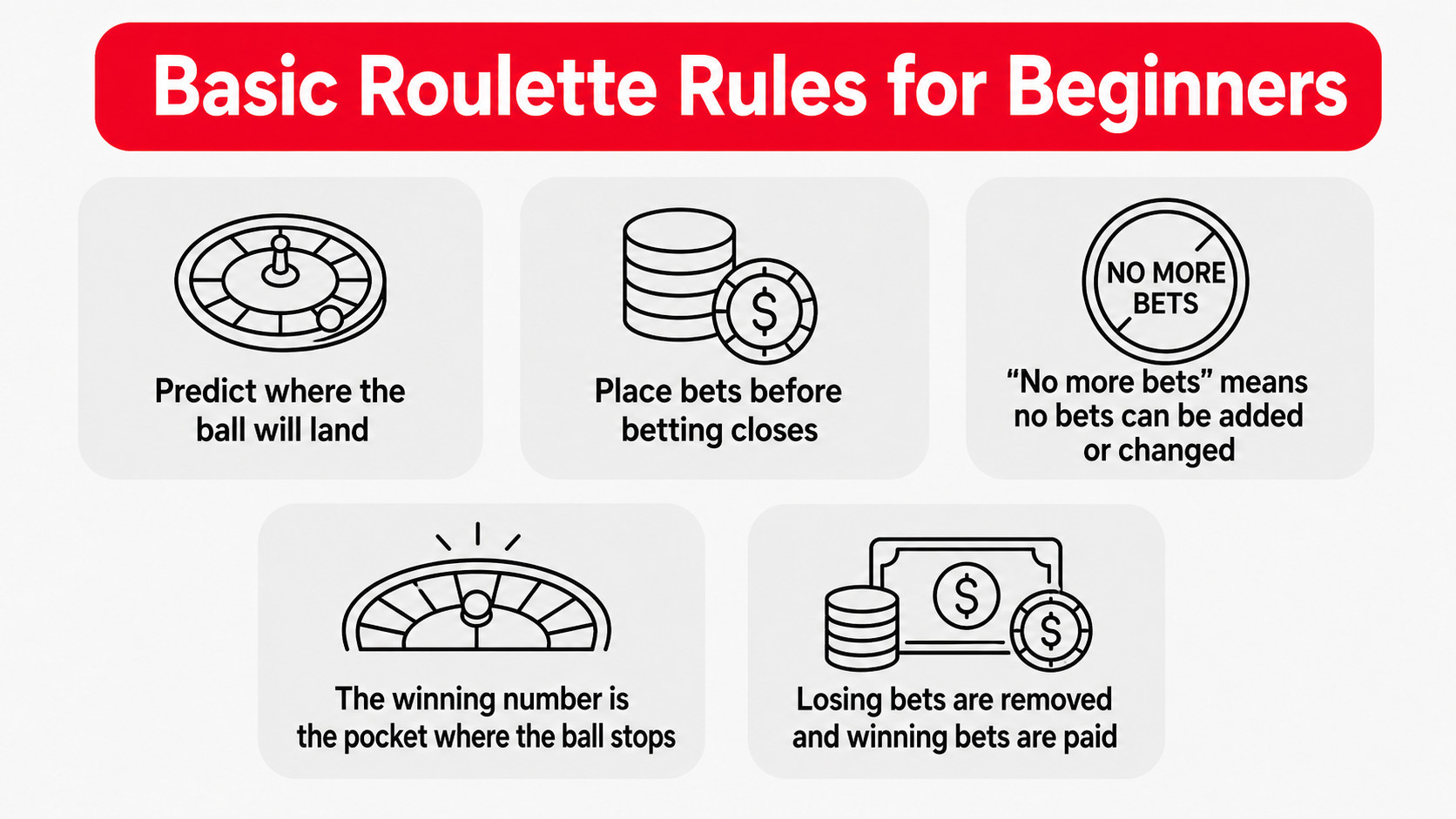
Every roulette table follows the same core rule set, no matter which variant you play. These rules cover the game’s objective, the betting window, and how winners get paid. The five sections below walk through each rule in order.
The Objective of Roulette
The objective of roulette is to correctly predict exactly where the ball will land on the spinning wheel. You win by betting on the exact number, a color, or a group of numbers before the spin closes. Every other roulette rule in this guide exists to support this one single goal.
- Bet on one number — bigger potential reward, higher risk
- Spread chips across several numbers or colors — steadier, smaller wins
Either approach follows the exact same basic objective, just with a very different level of risk and potential reward attached to it.
When Players Can Place Bets
Players can place bets from the moment the dealer clears the previous round of chips off the table. This open window stays open until the wheel and ball both start slowing down or a timer runs out.
| Table Type | Betting Window |
|---|---|
| Physical table | Open until the wheel and ball start slowing down |
| Online table | Fixed timer, commonly 15 to 20 seconds |
You can add, remove, or freely change your bets during this entire open window of time at the table. Once the dealer calls no more bets, the betting window closes completely and immediately for that specific round. Any chips placed after that exact call get returned to the player right away, without any penalty at all.
What “No More Bets” Means
No more bets means the betting window has fully and completely closed for that specific round of play at the table. The dealer says this phrase out loud and often waves a hand across the entire layout.
- No player can touch the table or their own chips
- No bets can be added, removed, or changed
- Touching your chips after the call can void your entire bet
Casinos enforce this rule strictly and consistently, both at online tables and at physical, land-based casinos worldwide.
How the Winning Number Is Determined
The winning number is whichever numbered pocket the ball finally rests in once the wheel stops completely.
- The ball bounces between several different numbers as it loses speed
- The ball settles into its one final pocket
- The dealer confirms the winning number
- The dealer places the dolly marker directly on top of it
That marker stays on the layout until every single bet gets fully paid or cleared away completely. No other pocket, including any the ball simply grazed along the way, has any effect on the final result of the round.
How Winning and Losing Bets Are Settled
Winning and losing bets always get settled in a fixed, consistent order every single round of play at the table.
- The dealer clears losing bets first, sweeping those chips off the layout
- Winning bets stay in place until the dealer calculates each payout
- Outside bets get paid before inside bets at most tables
- Chips get collected once every payout on the layout is complete
The full payout table for every single bet type appears later on in this same guide. Collect your winnings promptly, since some casinos limit exactly how long paid chips can sit on the layout.
How the Roulette Wheel Works
The roulette wheel decides every winning number through a simple mechanical process. Its number layout, colors, and pockets all follow a specific design. The four sections below cover how the wheel works and how it connects to your bets.
Roulette Wheel Numbers and Colors
Roulette wheels always hold numbers 1 through 36, plus at least one single dedicated zero pocket. These numbers do not run in simple, sequential numerical order around the actual wheel. Designers arrange them so high and low numbers, plus red and black colors, alternate as evenly as possible.
- 18 pockets are red
- 18 pockets are black
- 1 pocket is green (zero), or 2 on American wheels
This careful, very deliberate arrangement keeps every color and number range spread evenly all the way around the entire wheel, which helps the wheel stay balanced.
The Difference Between Zero and Double Zero
European wheels carry a single zero pocket, while American wheels add a second pocket labeled 00. That one extra pocket gives the casino a slightly bigger mathematical edge on every single bet placed.
| Feature | European | American |
|---|---|---|
| Zero pockets | 1 | 2 |
| Total pockets | 37 | 38 |
More pockets on the wheel always mean slightly lower odds for every player, no matter which specific number they choose. This difference is the single biggest factor separating the two main wheel types from each other. The exact house edge each wheel type produces gets covered in full further down this guide.
How the Ball Determines the Winning Number
The dealer spins the wheel, then rolls a small ball around a track sitting above the numbered pockets. As the ball loses speed, it drops from that track and bounces across the spinning wheel below. Small deflectors, called diamonds, scatter the ball’s path and add an extra layer of pure randomness.
The ball eventually settles into just one single pocket as the wheel slows all the way to a complete stop. That final pocket determines the official winning number for the entire round of betting. Casinos design this specific bounce-and-settle process to keep every single spin genuinely fair and unpredictable.
How the Wheel Connects to the Betting Table
The wheel’s number order has no direct connection at all to the betting table’s own layout design. The table lists numbers 1 through 36 in simple, sequential rows for easy, fast betting. The wheel itself scrambles that same full set of numbers around for balance and fairness.
Dealers memorize both layouts closely, so they can track results and pay out bets quickly and accurately every round. You never need to match the table’s row order to the wheel’s spinning order yourself at all. Just place your chips down on the table, and the dealer handles the rest of the process.
Types of Roulette Bets
Every roulette bet falls into one of three broad groups. Outside bets cover large sections of the wheel and pay less per win. Inside bets and call bets target smaller groups, so they pay more but hit less often.
Outside Bets (Best for Beginners)
Outside bets cover large groups of numbers spread across the layout in roulette games, so they tend to win more often. Red or black covers 18 numbers each on the wheel and pays even money on a winning spin. Odd numbers, even numbers, low numbers, and high numbers all work the same simple way as color bets.
Dozens and columns both split the entire betting layout into three equal groups of 12 numbers each. Both dozens and columns pay out at 2 to 1 on every winning bet you place. Start with outside bets first if you are completely new to roulette, since they carry the lowest overall risk.
- Higher chance to win each spin
- Easier for beginners to track
- Lower overall risk
- Lower payout per win
- Slower bankroll growth
- Less excitement per spin
Inside Bets (Higher Risk)
Inside bets target specific numbers directly on the layout grid, close to the center of the table. A straight bet on a single number pays out at 35 to 1, but it rarely actually wins. Split, street, and corner bets cover 2, 3, or 4 numbers at once, which spreads out your risk.
Smaller number groups on the layout always mean a smaller chance of winning on any given spin. In exchange for that lower chance, the payout climbs sharply compared to outside bets. Use inside bets in small amounts alongside a bigger, safer outside bet to balance your overall risk.
- Much higher payout per win
- Flexible bets on 1-4 numbers
- High reward potential
- Lower chance to win each spin
- Bigger bankroll swings can be influenced by the type of bet in roulette you choose.
- Higher overall risk
Call and Track Bets
Call bets group numbers together by their physical position on the wheel, not on the betting table. You call these bets out loud to the dealer, instead of placing chips onto the layout yourself.
- Voisins du Zero – numbers sitting close to the zero pocket on the wheel
- Orphelins – the leftover numbers not covered by the other two call bets
- Tiers du Cylindre – the third of the wheel sitting opposite the zero pocket
Staff at most European tables will place these bets on your behalf once you name them. Ask the dealer for help the very first time you want to try a call bet.
Roulette Payouts and Odds
Every roulette bet carries its own payout, odds, and built-in house edge. The table below breaks down the numbers for each common bet type. The section after that explains what the house edge actually means for your money.
Payout Table by Bet Type
Every bet type pays a fixed odds ratio, set in advance by the casino running the table. This holds true no matter which specific wheel you choose to play.
| Bet Type | Payout | Win Chance (European) |
|---|---|---|
| Straight up | 35 to 1 | 2.7% |
| Split | 17 to 1 | 5.4% |
| Street | 11 to 1 | 8.1% |
| Corner | 8 to 1 | 10.8% |
| Red/Black | 1 to 1 | 48.6% |
| Dozen/Column | 2 to 1 | 32.4% |
Lower win chances always pair with noticeably higher payouts across every bet type listed above. No single bet type gives you any real long-term edge over the house. Pick your bets based on your own risk appetite instead.
Which Bets Have the Best Odds?
Outside bets like red, black, odd, and even offer the best odds of winning any single spin. Inside bets like a straight-up number offer the worst odds, with barely a 3% chance of hitting.
Best to worst odds, by bet category:
- Outside bets (red, black, odd, even) — best odds, smallest payout
- Dozens and columns — strong odds, moderate payout
- Corner and street bets — moderate odds, bigger payout
- Split bets — lower odds, high payout
- Straight-up bets — worst odds, biggest payout
No bet type actually beats the house over the long run, no matter how good its odds look. Many players mix both bet types across a single session to balance the two.
House Edge Explained
The house edge is the casino’s average expected profit, calculated across every single bet placed over time. European roulette wheels carry a 2.7% house edge on almost every standard bet placed at the table. American wheels carry a much steeper 5.26% house edge because of that extra zero pocket, unlike French roulette which offers better odds.
This edge does not affect the outcome of any single spin you happen to play at the table. Over thousands of spins, though, that edge steadily eats into your entire bankroll. Pick European tables whenever possible, and skip the top line bet, which carries an even steeper edge on American wheels.
Popular Roulette Betting Strategies
Betting strategies change how you size your bets, not your actual odds of winning. Each system below follows a different pattern for raising or lowering your stake.
| Strategy | Bet Pattern | Risk Level |
|---|---|---|
| Martingale | Double bet after a loss | High |
| Reverse Martingale | Double bet after a win | Medium |
| D’Alembert | Raise or lower bet by one unit | Low |
| Fibonacci | Follow the Fibonacci sequence after a loss to enhance your roulette strategy. | Medium |
No strategy beats the house edge over the long run. Table limits and your own bankroll will always cap how far any system can run.
Common Roulette Mistakes for Beginners to Avoid
New roulette players tend to repeat the same few mistakes at the table. These habits drain your bankroll faster than the game itself. The next two sections cover the biggest ones and how to avoid them.
Chasing Losses
Chasing losses means raising your bet size right after a loss, hoping to win it all back fast. This habit empties bankrolls far faster than steady, flat betting ever will over a full session. Roulette has no memory at all, so past spins never affect what happens on the next one.
Set a firm loss limit for yourself before you even sit down at the table. Walk away the moment you hit that limit, no matter how the session actually feels in the moment. A short break away from the table resets your judgment better than one more desperate spin.
Ignoring Table Limits
Every roulette table posts a clear minimum and maximum bet somewhere near the wheel itself. Betting under that minimum, or over that maximum, simply is not allowed at that specific table. Check both limits carefully before you sit down and buy any chips from the dealer at that table.
High table minimums can drain a small bankroll within just a handful of quick spins. Low table maximums can also cap your winnings right when you finally hit a hot streak at the table. Match the table’s limits to your budget and your own goals before you ever start playing.
Essential Roulette Table Etiquette
Good table etiquette keeps the game fast and fair for everyone seated with you.
- Wait for the dealer to clear the table before placing new bets
- Never touch your chips once the dealer says no more bets
- Tip the dealer with a small side bet or cash if you win
- Keep drinks away from the betting layout
- Ask before you reach across another player’s section
Follow these habits, and dealers and other players will treat you the same way in return.
Where to Play Roulette Online
Look for a licensed online casino before you register or deposit any money. Check that the casino holds a license from a recognized regulator in your country. Read a handful of independent player reviews before you commit.
Live roulette streams a real wheel and dealer straight to your screen. RNG roulette uses computer software to generate each spin instead. Try both formats in demo mode first, if the casino offers one, before you play with real money.
| Feature | Live Dealer | RNG (Software) |
|---|---|---|
| Dealer | Real person on camera | Computer generated outcomes are common in online roulette games. |
| Pace | Slower, real-time spins | Instant results |
| Best for | An authentic casino feel | Fast, solo sessions |
Responsible betting in Roulette
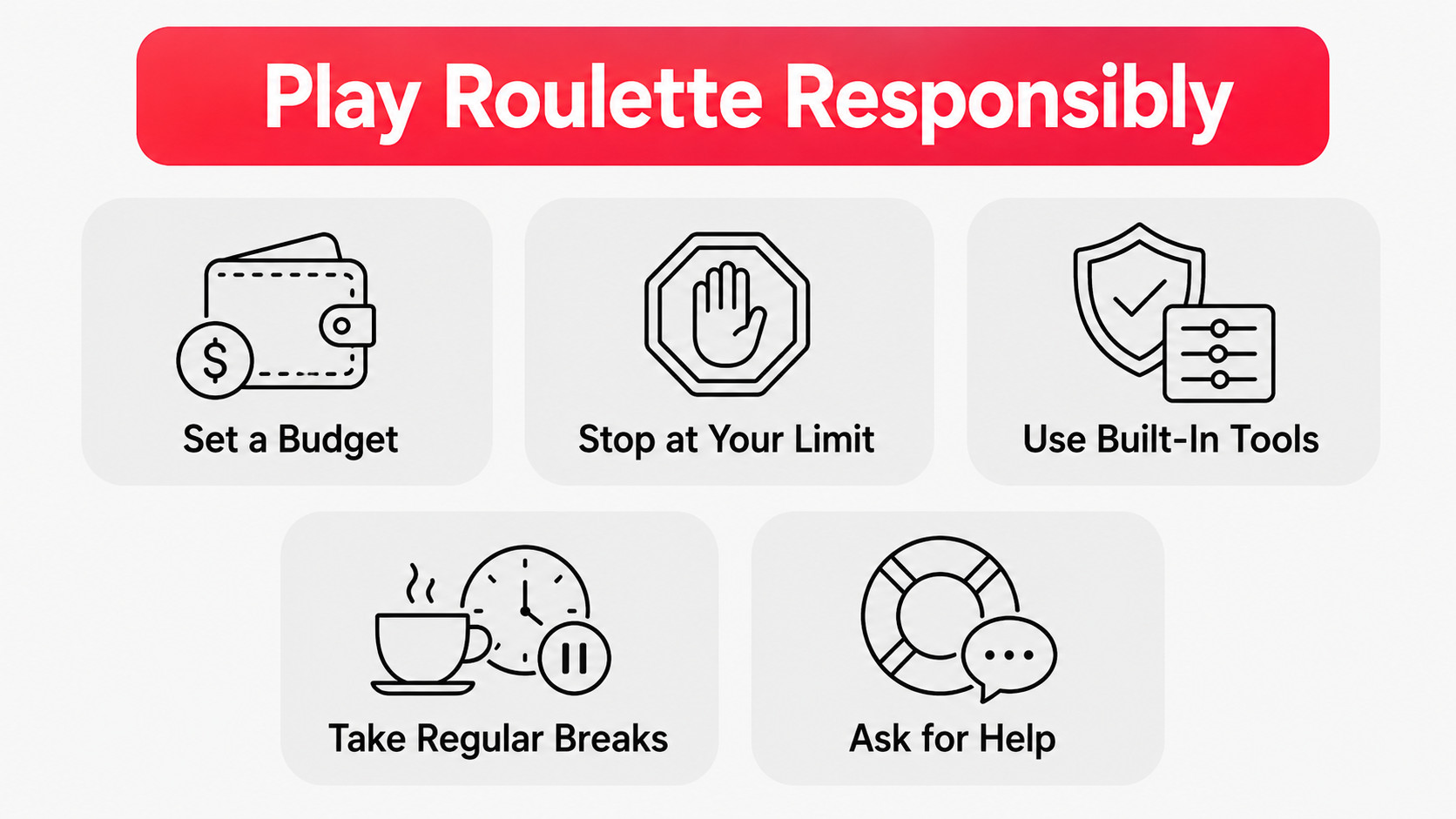
Set a strict budget for roulette before you sit down or log in. Treat that money as an entertainment cost, not an investment you expect to grow. Stop playing once you hit your budget, win or lose.
Use deposit limits and session timers if your casino offers them. Take regular breaks away from the table during long sessions. Reach out to a local support service right away if roulette ever stops feeling like a game. If you need a supportive community, organizations like Gamblers Anonymous are available worldwide. Reach out to a local support service right away if roulette ever stops feeling like a game.
Frequently Asked Questions About Roulette
What is the objective of roulette?
The objective of roulette is to correctly predict where the ball lands on the wheel. You win by betting on the right number, color, or group before the spin.
Is roulette a game of skill or luck?
Roulette is almost entirely a game of luck. Each spin is independent, so no amount of skill changes the outcome.
What is the best bet in roulette?
Outside bets like red, black, odd, and even carry the lowest house edge. They also give you the best odds of winning any single spin.
Can you win at roulette every time?
No betting strategy can guarantee a win on every spin. The house edge stays the same no matter how you size your bets.
What is the minimum bet at a roulette table?
Minimum bets vary by casino and by table, often starting between $1 and $10. Check the sign posted at the table before you sit down.
Are there any special rules in roulette?
Some European tables offer special rules like La Partage or En Prison on even-money bets. La Partage rules reduce the house edge by returning half your stake when zero hits.
What are the American roulette rules, and how do they differ from European wheels?
The American version of roulette follows the same betting structure but adds a second zero pocket. That extra pocket raises the house edge, so European wheels offer better odds overall.
What is live roulette?
Live roulette streams a real wheel and a real dealer to your screen in real time. It combines the feel of a physical casino with the convenience of playing online.
Is online roulette fair, and can I play it anytime?
Licensed online casinos use certified random number generators, so playing online roulette stays fair on every RNG spin. You can play anytime in your browser or app, choosing between live dealer and RNG versions.