AI for Sports Betting Guide 2026
-
 Paulius Pazdrazdys
 -
23 Feb 20268 min. read

AI has become a practical component of sports betting. What once relied mostly on intuition and basic stats is now driven by probability models, data analysis, and automation. If you want to approach AI for sports betting in a smart and realistic way, keep reading.
Table of content
- Key Message: How to Use AI for Sports Betting
- How AI Is Changing the Sports Betting Industry
- What AI Can and Can't Do for You in Betting
- General-Purpose AI Tools for Betting Research
- Building an AI-Assisted Betting Strategy
- Probability in Practice: A Step-by-Step Example
- Real-World Applications
- Ethical Considerations
- The Future of AI for Sports Betting
Key Message: How to Use AI for Sports Betting
Use AI sports betting tools to analyze data, compare odds across bookmakers, and identify value bets – but treat predictions as research starting points, not guaranteed winners. Combine AI insights with manual context checks (injuries, team news), apply strict bankroll management, and track your results consistently to improve over time.
How AI Is Changing the Sports Betting Industry
Artificial intelligence in sports betting has become the backbone of the entire sports betting market. The integration of AI affects how sports betting operators set odds, how bettors find value, and how regulators maintain fair play.
Odds Now Move in Milliseconds
Speed is where AI for sports betting makes the most visible impact. Modern AI systems update in-play odds within milliseconds of any significant event – a goal, a red card, an injury – while human traders simply cannot react that quickly.
The moment a team scores, dozens of related markets need instant recalculation. Today’s automated sports betting platforms handle up to 100,000 price changes every second. With live betting now accounting for nearly 60% of the online market, this machine learning infrastructure has become essential.
Predictions Have Genuinely Improved
The research cuts through the marketing noise and tells a clearer story:
| What’s measured | Old-school methods | AI-driven models |
|---|---|---|
| Picking game winners | Around 50–60% | Between 70–85% |
| Beating the closing line | Rarely | 3–7% edge on average |
The best machine learning models now achieve highly accurate results – 75–85% accuracy – and consistently spot mispriced odds before the broader market catches on. Sports bettors using these tools properly can see a 15–20% improvement in their success rate.
Catching Cheaters Before They Cash Out
Match-fixing remains a serious threat, and predictive analytics has emerged as the most effective weapon against it. Leading integrity monitoring systems track roughly 850,000 sporting events across 70 sports each year, flagging more than 1,000 suspicious matches annually.
During 2022, AI-powered detection identified 438 suspicious matches – 36% of all cases that year. Ensemble learning models have reached over 92% accuracy when distinguishing legitimate matches from potentially fixed ones.
What This Means If You Actually Bet
Top online bookmakers pour serious money into machine learning algorithms – sharpening their pricing, spotting informed money, staying one step ahead. Ordinary bettors can now access similar technology, but expectations need to stay grounded.
AI in betting helps by chewing through massive datasets, tracking line movements, and flagging patterns you’d never spot alone. It falls short at eliminating the randomness that makes sport impossible to predict with certainty.
What AI Can and Can’t Do for You in Betting
Before downloading any AI tool, understand what you’re getting. Using artificial intelligence for sports betting means accepting both its power and limitations.
- Processing thousands of data points in seconds
- Comparing odds across dozens of bookmakers
- Identifying patterns invisible to manual analysis
- Removing emotional bias from decisions
- Predicting random events – injuries, red cards
- Accounting for intangibles like team morale
- Performing reliably when historical data limited
- Guaranteeing profits on any individual bet
AI earns its place when you give it a specific job. It thrives where patterns hold predictive value and sports data is plentiful. If your betting suffers because you chase losses or let emotion hijack decisions, these tools can bring the discipline you’re missing.
But AI cannot strip away the uncertainty that makes sport worth watching. A last-minute injury, a controversial red card, an off day for a key player – none of these fit neatly into models built on historical data.
General-Purpose AI Tools for Betting Research
According to recent studies, bettors who conduct thorough pre-match research improve their decision-making quality by up to 20% compared to those who rely solely on intuition. These general-purpose AI tools can reduce research time from hours to minutes while covering more data points.
Perplexity
Perplexity is a versatile tool for gathering information quickly, so it is a great asset if you’re looking to stay informed. It provides updates on team news, injury reports, and historical statistics. What sets Perplexity apart is its ability to cite sources, ensuring that the information is reliable and accurate.
Key features for bettors:
- Processes over 1 billion queries monthly with real-time web access.
- Provides source citations for every claim – essential for verifying injury news or lineup changes.
- Free tier allows unlimited quick searches.
- Pro version (USD 20/month) offers deeper analysis.
Example: If you’re interested in how a team’s key injury affects its chances, Perplexity can provide up-to-date news and relevant historical performance data.
For instance, searching “Liverpool win rate without Mohamed Salah” returns sourced statistics within seconds, showing their historical record drops by approximately 15% without key players.
Best suited for: Bettors needing quick access to verified news and team stats to inform their decisions.
ChatGPT / Claude
Tools like ChatGPT and Claude can help to better understand betting strategies, explain odds calculations, and summarize key match details. They are useful for breaking down complex concepts such as value betting or risk management strategies.
Key features for bettors:
- ChatGPT Plus ( USD 20/month) and Claude Pro (USD 20/month) offer extended context for complex analysis.
- Can process and analyse uploaded data – betting history spreadsheets, statistical tables.
- Useful for calculating expected value, implied probabilities, and Kelly Criterion stakes.
Example: If you’re unsure about the intricacies of betting odds or a specific strategy, you can ask these tools to clarify things like point spread betting or the principles behind betting value.
For instance, asking “Calculate the implied probability and expected value if I bet USD 50 on odds of 2.40 when I estimate true probability at 45%” returns instant calculations showing EV = +USD 4.00 per bet.
Best suited for: Bettors seeking clear explanations of betting concepts and strategies without the need for extensive research.
Gemini
Gemini integrates seamlessly with Google Search to pull real-time data on upcoming fixtures and team form. By gathering information from a variety of sources, it provides quick insights into team dynamics, player conditions, and match previews.
Key features for bettors:
- Direct integration with Google’s search index – access to the freshest data available.
- Free tier with generous usage limits; Advanced version (USD 20/month) includes extended features.
- Strong at synthesising information from multiple news sources into concise summaries.
Example: Before placing a bet, you can use Gemini to check a team’s form over the past few weeks or even get the latest injury reports.
Asking “Arsenal last 10 matches results and goals scored” provides an instant form summary, helping you decide whether a team is trending positively or negatively.
Best suited for: Bettors who need quick, reliable updates and insights on team performance and upcoming fixtures.
AI Tool Cost Comparison
Understanding the cost of AI for sports betting tools helps you decide which fits your betting budget and frequency.
| Tool | Free tier | Paid tier | Best value for |
|---|---|---|---|
| Perplexity | Unlimited basic searches | USD 20/month (Pro) | News and source verification |
| ChatGPT | Limited GPT-4 access | USD 20/month (Plus) | Strategy explanations and calculations |
| Claude | Limited usage | USD 20/month (Pro) | Long-form analysis and data processing |
| Gemini | Generous free access | USD 20/month (Advanced) | Real-time form and fixture data |
For most recreational bettors, free tiers provide sufficient functionality. Serious bettors placing 20+ bets monthly may find paid versions worthwhile for speed and depth.
Building an AI-Assisted Betting Strategy
AI in sports betting tools are most useful when integrated into a structured approach. The goal is betting more selectively, not more often.
A Practical Workflow
Follow these steps to get the most from your AI tools:
- Use AI to shortlist potential bets – Let the tool surface opportunities based on your criteria.
- Check context manually – Team news, motivation, injuries, weather.
- Compare odds across bookmakers – Ensure you’re getting the best price.
- Place bets only when value is clear – Skip anything marginal.
- Track results consistently – Review performance weekly or monthly.
Bankroll Management Remains Essential
Betting with AI doesn’t change the need for fixed staking rules. Flat stakes or small percentage stakes (1–3% of bankroll) remain safest. AI could help find better opportunities, but cannot protect you from poor money management.
Common Mistakes to Avoid
Most bettors who fail with AI do so because they misuse it, not because technology lets them down. Watch out for these traps:
- Over-relying on a single tool – No model captures everything.
- Ignoring context – AI cannot watch matches or read body language.
- Chasing losses with larger stakes – Tools amplify discipline problems.
- Switching tools after losing streaks – Short-term variance is normal.
Probability in Practice: A Step-by-Step Example
Here’s how the maths works in a real betting scenario:
- Your tool estimates Team A wins 55% of the time.
- Bookmaker odds are 2.10. Implied probability = 1 ÷ 2.10 = 47.62%
- Edge = 55.00% − 47.62% = 7.38%
- Many bettors only act when edge exceeds 3–5%, accounting for model error.
- Stake with discipline – flat stake or small bankroll percentage.
This approach turns gambling into pricing decisions. You’re asking “Are these odds too generous?” rather than “Will Team A win?”
Real-World Applications
AI for betting becomes most valuable when applied to specific, repeatable tasks.
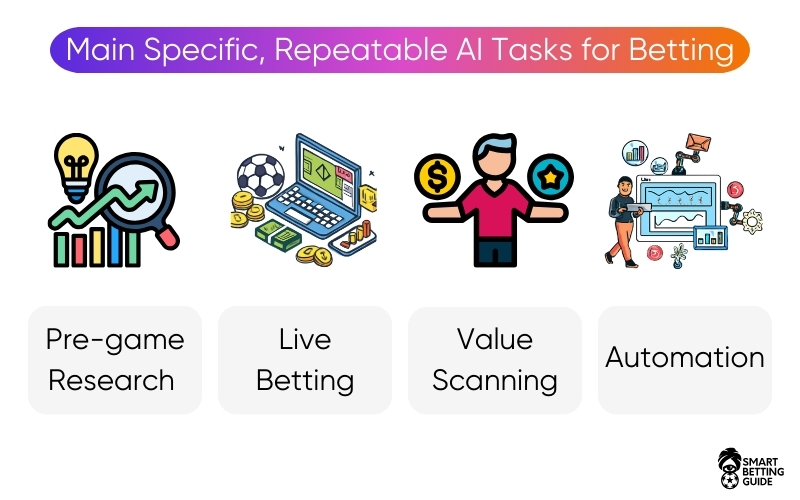
Pre-game Research
Value models flag matches where odds appear misaligned. AI sports betting predictions provide genuine insight as filtered starting points.
Live Betting
Real-time tools adjust probabilities as matches unfold. Watching live sports alongside data gives you the best betting experience.
Value Scanning
These tools are good at spotting pricing gaps across markets. Your role is confirming whether gaps reflect genuine value.
Automation
Alerts and shortlists reduce decision fatigue – a level of personalization that manual research cannot match.
Ethical Considerations
As AI becomes central to sports betting, ethical considerations deserve attention. AI offers operators tools to personalize experiences and offer tailored betting recommendations based on a user’s betting history. Responsible operators use AI to create safer environments – identifying problem gambling patterns.
For individual bettors: use AI for informed betting decisions, not to chase unrealistic profits or gamble beyond your means.
The Future of AI for Sports Betting
AI for sports betting is becoming more personalised – models are adapting to individual betting styles, preferred markets, and risk tolerance. Companies like Genius Sports are pushing the boundaries of real-time sports analytics.
At the same time, bookmakers are improving their own models. The edges available today may shrink as technology becomes standard. The future of AI in sports belongs to those who treat artificial intelligence as a sharpening tool, not a replacement for thinking.
FAQ About AI for Sports Betting
⭐ What is AI for sports betting?
AI for sports betting refers to tools that analyze large data sets to estimate probabilities, identify patterns, and support betting decisions using algorithms and machine learning.
⭐ Can AI betting tools really improve results?
Artificial Intelligence betting tools and AI betting tips can improve decision quality by reducing emotional bias and speeding up analysis, but they don’t guarantee profits or eliminate risk.
⭐ Is AI betting software legal?
In most countries yes – using AI for sports betting is legal, but regulations vary – always check local laws and bookmaker rules.
⭐ Do beginners benefit from AI sports betting tools?
Yes, beginners can benefit by learning structured ai betting analysis and discipline, as long as they avoid overreliance and unrealistic expectations.
⭐ What is the best AI for sports betting?
There’s no single best option for choosing Artificial Intelligence for betting– the right choice depends on your betting style, preferred markets, and how much control you want over decisions.