Formula 1 Betting Guide: How to Bet on F1 Racing?
-
 Dalius Mikalauskas
 -
12 Mar 202613 min. read

Want to bet on Formula 1 but not sure where to start? Here we cover everything you need to know about Formula 1 betting – from how odds work and which markets are available to proven strategies that can help you make smarter picks on race day.
Table of content
Key Takeaways
- Formula 1 offers various betting markets, from outright winners to niche prop bets.
- Understanding betting odds and how they reflect probability is essential before betting.
- Track characteristics, weather, qualifying results, and pit strategy all shape race outcomes.
- Value betting and bankroll management matter more than chasing favorites.
- Always choose licensed, regulated bookmakers and bet responsibly.
Why Bet on Formula 1?
Every Grand Prix weekend gives you multiple sessions to analyze. Free practice, qualifying, sprint races, and the main event all produce fresh data and shifting odds.
Unlike team sports where form can stay relatively flat for weeks, F1 conditions change from circuit to circuit.
A dominant team in Monza might struggle in Monaco. A driver who thrives in the rain could suddenly become a serious value pick when storms roll in. Once you bet on Formula 1 for the first time, you quickly realize how much depth there is to explore.
We think one of the biggest draws of F1 betting is the sheer variety of betting options available. You are not limited to picking a race winner.
You can bet on:
- Podium finishes
- Head-to-head matchups
- Fastest laps
- Pole position
- Safety car appearances
Each betting market rewards a different kind of analysis, so there is always room to find an edge if you put in the work.
The sport also has a truly global calendar, with over 20 F1 races each season spanning five continents. That means betting opportunities stretch almost year-round, from March to December. Whether you have a passion for F1 or you are simply looking for a new sports betting challenge, this is a sport that rewards knowledge.
How F1 Betting Works
If you are new to betting on motorsport, such as F1 or Speedway bets, it helps to understand the basic mechanics first. Here is a breakdown of how odds work, what types of bets are available, and how pre-race and live betting differ.
Understanding F1 Betting Odds
F1 betting odds tell you two things – how likely an outcome is according to the bookmaker, and how much you stand to win. The three main formats are decimal, fractional, and American.
| Odds Format | Example | What It Means |
|---|---|---|
| Decimal | 3.50 | You get USD 3.50 back for every USD 1 staked (including your stake) |
| Fractional | 5/2 | You win USD 5 for every USD 2 staked, plus your original stake |
| American | +250 | You win USD 250 on a USD 100 bet (positive = underdog) |
Most international bookmakers default to decimal odds because they are the easiest to calculate. Simply multiply your stake by the decimal number to find your total return.
One thing we always recommend is comparing odds across multiple bookmakers. Prices for the same driver can vary significantly, and even small differences add up over the course of the season. Looking for the best odds before you place a bet is one of the simplest ways to improve your returns.
Pre-Race vs. Live F1 Betting
Pre-race betting is the traditional approach. You study the data, place bets before the lights go out, and wait for the result. Most bettors start here because it gives you time to research properly.
Live betting lets you place wagers during the race itself. Odds shift in real time based on what is happening on track. If there is a first-lap incident, a surprise pit stop, or a sudden change in weather, the in-play odds react immediately.
For example, if a front-runner pits early and drops back temporarily, their odds to win the Grand Prix might jump – creating a window for a well-timed bet.
Types of F1 Bets: All Major Betting Markets
This is where things get interesting. F1 offers more types of bets than many people realize. Here is a closer look at every major option available to you.
Let’s have a quick breakdown:
| Bet Type | What You’re Predicting | Risk Level |
|---|---|---|
| Race Winner | Which driver will win the race | High |
| Podium (Top 3) | Whether a driver finishes in the top three | Medium |
| Top 6 / Top 10 | Whether a driver finishes in the top 6 or top 10 | Low–Medium |
| Pole Position | Which driver sets the fastest qualifying lap | Medium |
| Fastest Lap | Which driver records the fastest lap in the race | High |
| Head-to-Head | Which of two drivers finishes higher | Low–Medium |
| Constructor / Team Bets | Which team finishes highest or wins the championship | Medium |
| Futures / Championship | Season-long champion (Driver or Constructor) | Medium–High |
| Special / Prop Bets | Specific race events (Safety Car, DNFs, red flag, etc.) | High |
Race Winner Bets
The most straightforward type of bet in Formula 1. You simply bet on which driver will cross the finish line first. Because F1 fields are small (typically 20 drivers) and the top teams tend to dominate, favourites as F1 arrives at each new venue often carry short odds.
That said, surprises do happen – rain, mechanical failures, and first-lap chaos can turn any race upside down, and a less-fancied driver winning is never out of the question.
For example, if Max Verstappen is listed at 2.50 to win the Dutch Grand Prix and you bet USD 20, your return would be USD 50 (including your stake) if he wins. Race winner bets are the most popular way to bet on F1 for beginners and experienced bettors alike.
Podium Finish Bets (Top 3)
This market asks whether a F1 driver will finish in the top three. It is less risky than betting on the winner because you are covering three positions instead of one.
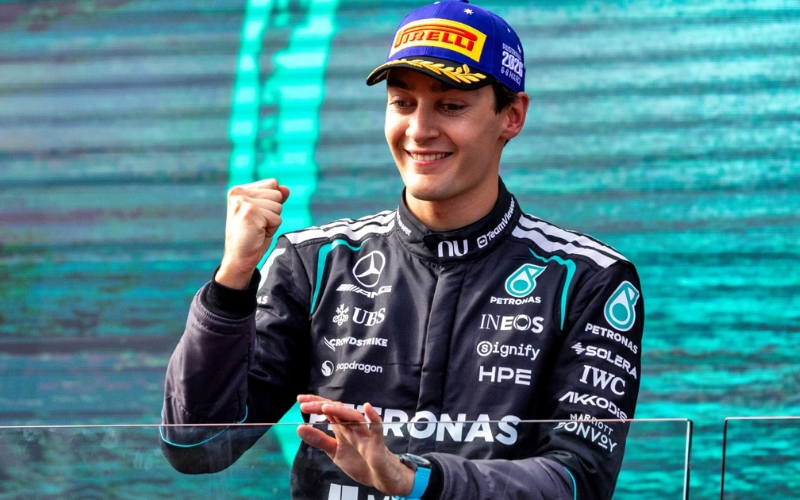
Podium bets are popular for drivers like Charles Leclerc or George Russell – strong enough to finish on the podium consistently but not always carrying the lowest odds to win outright.
Top 6 and Top 10 Finish Bets
These are sometimes called “points finish” bets, since the top 10 all score World Drivers’ Championship points. Top 6 and top 10 bets are great for finding value on midfield drivers who consistently perform well but do not make headlines. A reliable driver in a competitive midfield car can offer solid odds in this market.
Pole Position Bets
Pole position bets are settled after qualifying, not the race. You are betting on who will set the fastest qualifying lap in Saturday’s session.
This market rewards those who study practice session data closely, as qualifying pace does not always mirror race pace. Charles Leclerc, for instance, has often been a strong qualifier even when his race results told a different story.
Fastest Lap Bets
The fastest lap bet is settled by whoever manages to record the fastest lap during the race. This often goes to a driver on fresh tyres near the end, especially if they have a gap to the car behind.
Teams sometimes pit a driver specifically to chase the fastest lap bonus point – a tactic Red Bull have used effectively in recent seasons.
Head-to-Head Driver Bets
In a head-to-head bet, the F1 bookmaker pairs two drivers and you pick which of the two drivers will finish higher. It does not matter where they finish overall – only their position relative to each other counts.
This is one of our favorite F1 betting markets because it lets you focus on individual matchups rather than the entire field. If you are still learning how to bet on F1, head-to-head bets are a great starting point because they simplify your analysis.
Constructor and Team Bets
You can also bet on which constructor finishes highest in a race or wins the Constructors’ World Championship.
Team bets add another layer of F1 strategy because you are effectively betting on both of the team’s drivers combined. Watching how Red Bull, Mercedes, or Ferrari perform across different circuit types gives you an edge in this market.
F1 Futures and Championship Bets
Futures bets are placed on season-long outcomes. The most common are the Drivers’ Championship and the Constructors’ Championship. Early-season futures often offer better value because there is more uncertainty about which driver might become world champion.
As the season progresses and the championship leader pulls ahead, the odds tighten. Bettors who spotted Verstappen’s dominance early in recent years found excellent value in the futures market.
Special and Prop Bets
Prop bets cover events within a race that go beyond betting on the winner. Here are some common ones:
- Whether a safety car will be deployed during the race
- How many drivers will fail to finish (DNFs)
- Total number of overtakes
- Whether there will be a red flag
- Which driver retires first
These markets are fun and can be profitable if you study circuit history. Street circuits like Monaco tend to produce more safety cars, while high-speed tracks often see fewer interruptions. Prop bets also add variety to your overall betting experience.
Key Factors That Affect F1 Betting Outcomes
Betting on Formula 1 without doing your homework is essentially guessing. Here are the critical factors we consider before placing any bet.
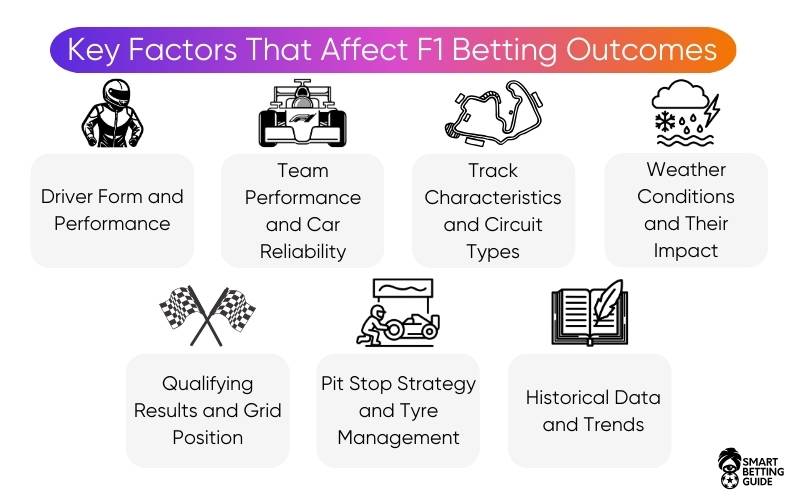
Driver Form and Performance
Recent results matter. A driver on a hot streak often carries confidence and momentum into the next race weekend. Look at the last three to five results, but also pay attention to whether those results came on similar circuit types. Driver form is one of the first things we check, and so should you.
Team Performance and Car Reliability
In Formula 1, the car often matters more than the driver. This is something you should always keep in mind when evaluating Formula 1 odds.
Car upgrades introduced mid-season can also shift the competitive order. Lewis Hamilton’s move to Ferrari, for instance, is the kind of shift that can reshape what the odds say about who might compete for the title.
Track Characteristics and Circuit Types
Not every Formula 1 circuit suits every car. F1 tracks generally fall into a few categories.
- High-downforce circuits (Monaco, Singapore) reward cars with strong aerodynamic grip.
- Power circuits (Monza, Spa) favor cars with straight-line speed.
- Street circuits (Jeddah, Baku) are bumpy and narrow, increasing the chance of safety cars and incidents.
- Technical circuits (Barcelona, Suzuka) require an all-round strong car.
Understanding which type suits which team helps you make smarter selections.
The Las Vegas Grand Prix, for example, is a street circuit that also features long straights – creating an unusual mix that can catch some bettors off guard.
Weather Conditions and Their Impact
Rain is the great equalizer in F1. Wet conditions reduce the advantage of having a faster car and put more emphasis on individual driver skill. Lewis Hamilton and Max Verstappen are both known for excelling in the wet, and their odds in rainy conditions often do not fully reflect their ability.
Always check the weather forecast before placing pre-race bets – what the odds for this weekend’s race look like on Thursday can change dramatically by Sunday.
Qualifying Results and Grid Position
Starting position has a huge influence on race outcomes, especially at circuits where overtaking is difficult. Research published in the International Journal of Performance Analysis in Sport found that the probability of a driver winning from pole position was roughly 60%, and it decreased progressively for each grid slot further back.
Grid position alone will not tell you who will win the race, but it is one of the strongest predictors available. If you want to know how to bet on F1 races effectively, always check the qualifying results first.
Pit Stop Strategy and Tyre Management
Pit stops can make or break a race. The “undercut” (pitting before your rival to gain track position on fresh tyres) and the “overcut” (staying out longer on older tyres) are common strategic weapons. Teams that manage tyre degradation well tend to gain an advantage in the second half of races.
If you notice during practice sessions that a team’s tyre wear is lower than expected, that is valuable information for your bets.
Historical Data and Trends
Past performance at specific circuits is a powerful indicator. Some drivers and teams simply perform better at certain tracks year after year.
Hamilton’s record at Silverstone or Verstappen’s dominance at Zandvoort are well-known examples. Checking historical data before betting on any race gives you extra context that pure driver form analysis might miss.
F1 Betting Strategies and Tips
Knowing the markets and factors is only half the battle. You also need a solid F1 betting strategy to guide how you place bets. There are some approaches we find most effective.
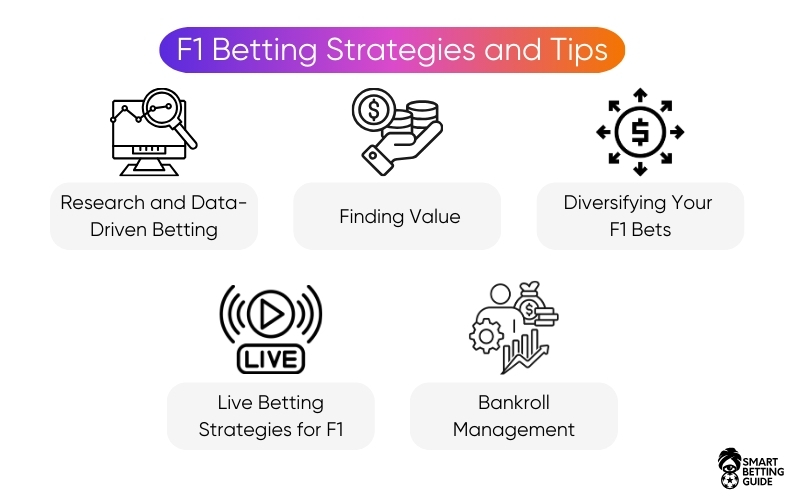
Research and Data-Driven Betting
Do not skip practice sessions. Free practice lap times, long-run pace data, and sector times all give you insights that pre-race odds have not fully accounted for.
If you want to know how to bet on F1 racing with confidence, data is your best friend. Telemetry-based analysis from sources like the official F1 app can reveal which teams are sandbagging and which are genuinely quick.
Finding Value: Exploiting Market Inefficiencies
Value betting means finding odds that are higher than what you believe the true probability should be. If you think a driver has a 25% chance to finish in the top three, but the bookmaker’s odds imply only a 15% chance, that is a value bet.
Over time, consistently identifying these discrepancies is what separates profitable bettors from casual ones. A former world champion trading at generous odds on a track that suits them is exactly the kind of opportunity worth looking for.
Diversifying Your F1 Bets
Do not put all your money on one market. Mix short-term race bets with longer-term futures. Combine outright winner picks with head-to-head matchups and prop bets. Diversification spreads your risk and gives you more betting opportunities to profit across a race weekend.
Live Betting Strategies for F1
The key to a strong F1 betting strategy for live races is preparation. Know the likely pit window before the race starts. Understand each team’s tyre strategy. That way, when the race unfolds and odds shift, you can act quickly and with confidence rather than guessing.
Watch for these common in-play opportunities.
- A front-runner pitting early and temporarily dropping down the field
- A safety car bunching the field and resetting gaps
- A sudden weather change that favours certain drivers
- A midfield driver running unexpectedly high after a chaotic opening lap
Bankroll Management for F1 Betting
Set a budget for each race weekend and stick to it. We recommend staking no more than 2-5% of your total bankroll on any single bet. This protects you from big losses and keeps you in the game for the long run. Avoid chasing losses after a bad result – emotional betting is the fastest way to drain your account.
How to Choose the Best F1 Betting Site
Not all sportsbooks are created equal, especially when it comes to motorsport coverage. When picking one, try to look at a few specific points.
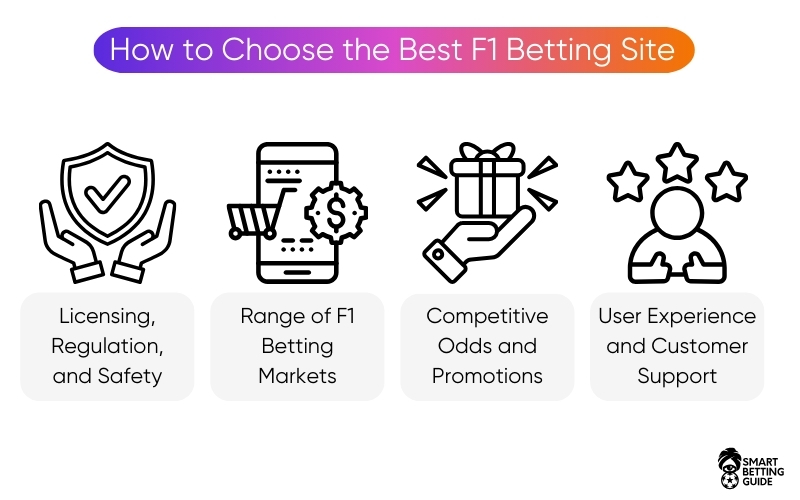
Licensing, Regulation, and Safety
Always use a licensed bookmaker. Reputable online betting platforms operate under regulatory bodies that ensure fair play, data protection, and secure transactions. Check for licensing information in the site’s footer before signing up.
Range of F1 Betting Markets
The best betting sites offer a wide selection of markets for every session – practice, qualifying, sprint races, and the main Grand Prix. If a bookmaker only offers race winner and championship bets, you are limiting your betting options.
Competitive Odds and Promotions
Compare competitive odds across at least two or three bookmakers before placing a bet. Some sites also run F1-specific promotions, such as enhanced odds for qualifying or free bets on race day. Keep an eye out for free bets especially around high-profile F1 races, as they give you a chance to bet on F1 with reduced risk.
User Experience and Customer Support
A clean, intuitive interface makes a real difference – especially for live betting where speed matters. Look for reliable mobile betting apps, fast loading times, and responsive customer support via live chat or email. Easy access to a variety of payment methods is also a plus.
Responsible Gambling When Betting on F1
Betting on Formula 1 should be enjoyable, not stressful. If you ever feel like betting is becoming more than entertainment, it is time to step back and reassess.
Here are a few ground rules we strongly encourage you to follow.
- Set a budget before each race weekend and never exceed it.
- Take regular breaks from betting, especially during long seasons.
- Never bet money you cannot afford to lose.
- Use deposit limits and self-exclusion tools that most regulated bookmakers offer.
- If you feel you may have a gambling problem, reach out to organizations like GamCare or Gamblers Anonymous for confidential support.
Betting should enhance your enjoyment of the sport, not take away from it. Treat it as a form of entertainment with a budget, just like any other hobby.
FAQ About Formula 1 Betting
🏎️ What are the key changes in F1 regulations for 2026?
The 2026 F1 season brings significant changes, including new car designs, updated engine regulations, and a rise in the cost cap.
🏎️ Is F1 betting legal?
F1 betting is legal in many countries, but regulations vary by jurisdiction. Always check your local gambling laws and use licensed, regulated sportsbooks to ensure you are betting legally and safely.
🏎️ What is the most popular F1 bet?
The race winner bet is the most popular market. Podium finish and head-to-head driver bets are also widely placed among bettors who follow the sport closely.
🏎️ Can you bet on F1 races live?
Yes. Most major bookmakers offer live or in-play betting on F1 races, with odds updating in real time throughout the event.
🏎️ How do F1 betting odds work?
Formula 1 odds represent the implied probability of an outcome and determine your potential payout. Decimal odds are the most common format internationally. Multiply your stake by the decimal odds to calculate your total return.
🏎️ What factors should I consider before placing an F1 bet?
Focus on driver form, team performance, track characteristics, weather forecasts, qualifying results, and pit stop strategy. Combining these factors gives you a much clearer picture than relying on any single metric.

Crypto and Sports Betting Expert